 Norsk bokmål
 English
 日本語
 Deutsch
 한국어
 العربية
 Русский
 Türkçe
 Português
 Français
 Español
 Italiano
 Nederlands
 Polski
 Bahasa Indonesia
 Tiếng Việt
 ไทย
 Bahasa Melayu
 हिन्दी
 Română
 Svenska
 Čeština
 Ελληνικά
 Українська
 עברית
 فارسی
 Dansk
 Suomi
 Magyar
 বাংলা


Scented Candle Vessel Design: Glass Shapes, Surface Textures and Home Fragrance Collections
A fragrance brand chooses a sculptural glass cup for its next candle. The color is beautiful, the texture catches the light, and the lid looks perfect beside a matching reed diffuser. Then the candle maker asks a different set of questions: Is the glass intended for a burning candle? Will the complete wax-and-wick combination perform safely? Can the decorative finish withstand the actual use conditions?
A decorative vessel is not automatically a suitable candle container. Scented candle glass vessel design has two connected jobs: develop a recognizable home-fragrance collection and establish that the proposed container and finished candle can meet the relevant safety requirements.
This guide focuses on the design decisions a brand can make before sampling, and the checks that must remain separate from appearance approval.
Choose a Glass Shape That Can Anchor the Collection
Straight-Sided Cylinders: A Reliable Visual Starting Point
A straight cylindrical glass vessel gives a fragrance brand a flexible design foundation. Its continuous body offers a clear area for a wordmark, colored coating or simple label, and the silhouette works across minimalist, botanical and contemporary ranges.
For a collection with several scents, keep the vessel shape consistent and change controlled elements such as the label, color or lid detail. This makes it easier to recognize the range without developing a different jar for every fragrance.
Existing-mold options may be available, but stock glass is not automatically approved for candles. Confirm the intended application.
Heavy-Base Glass: Visual Weight With Real Trade-Offs
A thick transparent base can create a floating-wax impression and attractive light refraction. It also adds weight, which may influence perceived quality, shipping costs and handling. Evaluate shipping weight when designing gift sets.
The base needs more than visual approval. Its external standing surface should be stable, while the internal base shape must work with the candle maker's proposed wax fill and wick arrangement. A thick base does not, by itself, prove that the container is suitable for candle burning or thermal changes.
Review the complete drawing and filled sample, not catalogue photos alone.
Curved, Tapered and Sculptural Vessels
A softly tapered wall, subtle inward shoulder or irregular outer profile can make a candle recognizable before the label is read. These forms may change the opening, usable volume and glass-forming requirements.
For custom tooling, the manufacturer must review glass distribution, mold release and dimensional feasibility. The candle maker must separately evaluate the proposed geometry as part of the finished candle system. A narrow opening or unusual interior should not be selected solely for its silhouette.
Design decision: Choose the primary shape for recognizable branding, then confirm it can proceed to candle-specific evaluation before investing in decorative finishes or custom molds.
Use Surface Texture to Create a Signature Look
Texture can make related fragrances feel like a collection even when each scent has its own color. Separate molded features from later decoration.
Full frosting creates a soft, diffused finish suited to understated interiors. Partial frosting keeps a clear area for a label or a view of the wax. Acid etching, sandblasting and matte coating can create different effects; a specification should identify which process is proposed rather than call every result simply "frosted."
Spray coating can create warm neutrals, dark smoke tones or seasonal colors. The coating must be assessed for the intended candle conditions. Inner coatings demand additional scrutiny because they may contact the wax and experience direct exposure to the candle environment.
Molded textures, such as ribs or shallow botanical relief, become part of the glass geometry. They can offer a tactile brand detail without relying entirely on printed decoration. However, prominent relief, fine lines and complex curves may affect forming feasibility and later label application. Our guide to molded glass embossing explains the tooling decisions in more detail.
Mineral and stone-like effects can provide a quiet, architectural look. A sprayed mineral-style coating, textured glass and a genuine stone or ceramic vessel are different constructions; do not describe a glass surface finish as natural stone. Any applied finish needs suitability checks.
Put the Detail Where It Belongs
Reserve an intentional front area for the brand name and fragrance label. Keep pronounced texture away from zones where a flat label needs reliable contact. Around the upper rim, avoid decorative features that could interfere with filling, normal handling or planned safety evaluations. On the base, preserve a stable contact surface and any area needed for identification or safety information.
Screen printing, metallic decoration and labels should be assessed on the final texture, not a smooth sample of the same glass. Fine lettering over deep ribs may become hard to read; a hot-stamped detail may require a different approved application area. Mark decoration boundaries in the approved artwork.
Design decision: Choose one signature finish and one restrained secondary detail. Too many competing textures make repeat orders and future fragrance launches harder to match.
Build a Home Fragrance Collection, Not Just One Candle Jar
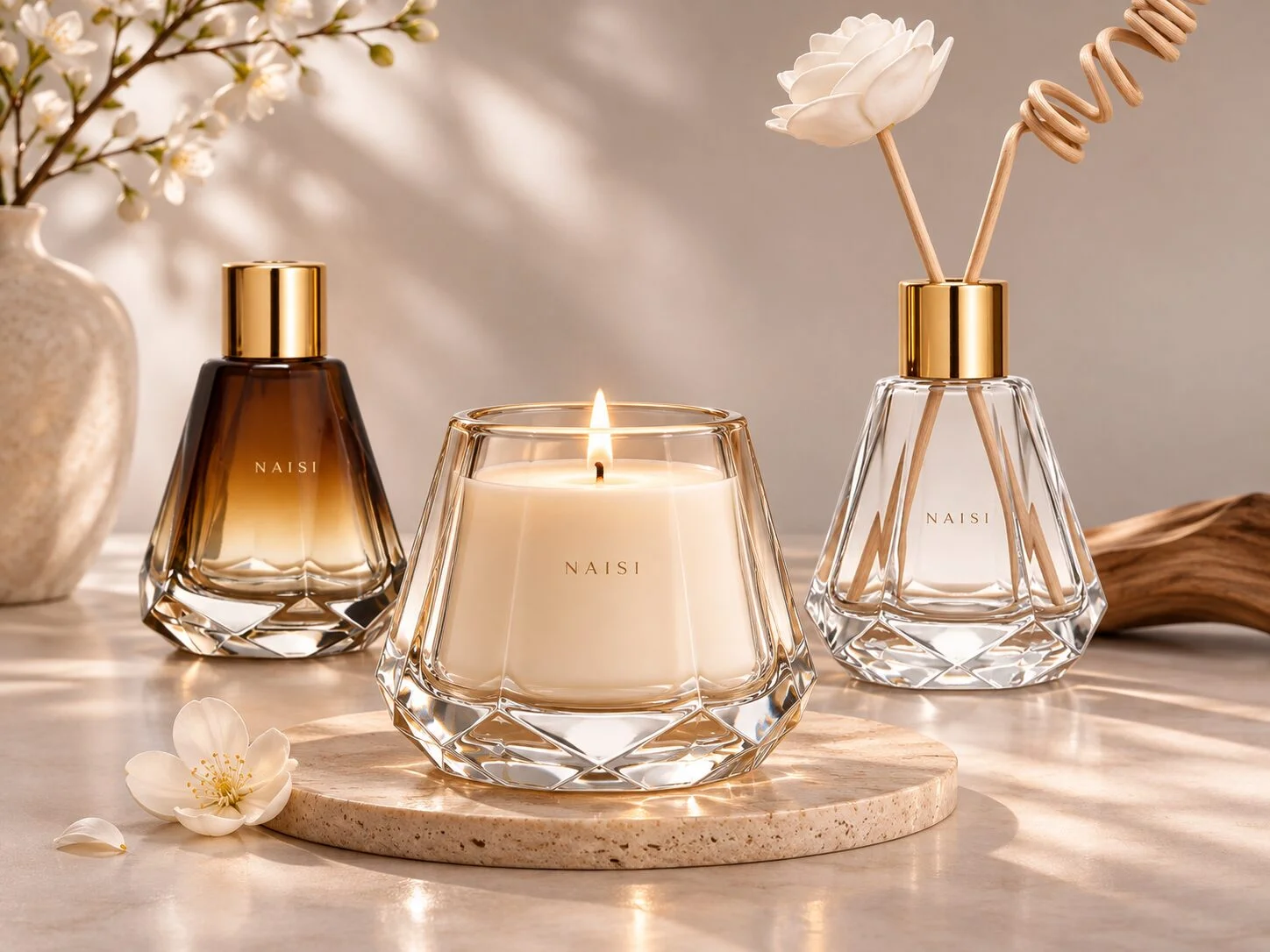
A coordinated collection can include a glass candle vessel, lid, reed diffuser bottle and gift box without making every component the same shape.
Start with three transferable design cues: a consistent color family, a repeated geometric feature and a shared finishing detail. For instance, a candle may use a softly fluted glass body, while the diffuser uses a simple bottle with a matching cap color and a smaller fluted accent. Their functions differ, but the collection remains recognizable.
Match Lids to the Vessel's Character
A wooden lid adds warmth to clear or amber glass. A metal-look lid can strengthen a refined, contemporary direction. A ceramic lid introduces matte texture and visual weight that may complement a mineral-effect vessel.
Beyond appearance, assess lid fit, handling, any liner or insert, and the way the lid will be used when the candle is unlit. Wood can be sensitive to moisture or fragrance exposure; metal may become hot near a heat source; ceramic adds weight and requires suitable fit protection.
Do not assume a decorative lid can remain on a candle during burning. Its intended use and any relevant safety warnings must be established for the finished product.
Carry the Design Into Diffusers and Gift Packaging
A reed diffuser is a logical extension for brands offering the same scent in flame-free and candle formats. Reuse a defined color, typeface, cap finish or texture rather than forcing a diffuser into the candle's proportions.
A diffuser needs an appropriate neck, closure and reed arrangement, plus compatibility with its own liquid formula.
For a visual reference, NAISI lists a round glass reed diffuser bottle that can help illustrate a coordinated home-fragrance direction.
The gift box completes the presentation. Its insert must hold each piece securely, especially where a heavy glass candle sits beside a taller diffuser. Check the assembled weight, orientation and protection during shipping. A beautiful display layout that lets glass pieces touch one another is not ready for distribution.
For a multi-scent range, vary controlled artwork details while retaining approved vessel and lid references.
Draw a Clear Line Between Appearance and Candle Safety
A decorative glass jar is not automatically a qualified candle vessel. A beautiful finish, thick base or supplier product photo cannot establish safe performance when wax and a lit wick are introduced.
The glass container should be assessed for its intended candle application, including relevant annealing and thermal-shock performance.
ASTM F2179-26 addresses annealed glass containers produced for candle use. That is a container-focused specification, not proof that a particular filled candle is safe.
The finished candle requires a separate evaluation with the selected wax, fragrance, wick or wicks, fill level and glass.
The test plan should consider relevant burn behavior, stability, container cracking, excess heat and other hazards under intended use conditions.
For market context, ASTM F2417-26 addresses candle fire safety, while EN 15493:2026 addresses fire-safety requirements and tests for indoor candles in the European standards framework. Applicable requirements vary by destination market and product configuration.
A passed glass assessment cannot replace full-candle burning evaluation; a successful candle burn trial on one construction cannot automatically approve a different wax, wick, vessel or decorative finish.
When Should Decoration Be Approved?
Select a candidate vessel and confirm its structural suitability for the planned candle-development program before committing to a complex finish.
Next, produce representative decorated samples and evaluate the completed candle system. If a coating, internal finish, wall geometry or wick configuration changes, determine what needs revalidation.
Appearance and safety assessments may progress in parallel, but neither replaces the other. The brand and candle manufacturer are responsible for arranging the appropriate product evaluations and market-specific compliance checks with qualified parties.
NAISI's packaging customization options should not be mistaken for an independent candle safety certification service.
A Practical Handover for Your Glass Packaging Supplier
An initial inquiry should identify intended use alongside the desired appearance.
|
Brand provides |
Packaging supplier or candle maker confirms |
|
Target wax fill, scent range and intended market |
Suitable vessel options and necessary safety evaluation route |
|
Desired glass shape, size and visual references |
Actual dimensions, capacity, wall and base construction |
|
Frosting, coating or texture references |
Decoration feasibility and sample finish on actual glass |
|
Lid material, color and packaging concept |
Closure fit, intended lid use and finished-pack practicality |
|
Planned candle and diffuser SKUs |
Separate functional requirements and coordinated appearance |
|
Estimated quantities and launch timing |
Available molds, sampling, customization and project lead time |
Compare physical samples as a full collection, keeping appearance approval separate from safety evaluation.
Frequently Asked Questions
Can any thick glass jar be used for a scented candle?
No. Thickness alone does not establish candle suitability. The glass must be appropriate for the intended application, and the finished wax-and-wick candle needs its own safety evaluation.
Can decorative coatings be used on glass candle jars?
Potentially, but suitability depends on the coating, its location and the conditions of use. Confirm the actual decorated vessel through the relevant evaluation process, especially for interior coatings.
Can a candle jar and reed diffuser share the same glass design?
They can share colors, textures and a visual family. They do not have to share the same container geometry; their functional and safety requirements differ.
Develop a Coordinated Home Fragrance Collection With NAISI Packaging
Distinctive scented candle glass vessel design combines a recognizable shape, considered surface details and a plan for extending the look into lids, diffusers and gift packaging. Candle safety must be evaluated separately from the appearance of the glass.
NAISI Packaging offers glass packaging and decoration options for home fragrance projects, including examples of glass candle jars, embossed glass vessels and reed diffuser bottles.
Product listings are starting points for design discussions, not evidence of completed candle safety testing.
Share your preferred vessel shape, target wax fill, lid concept, decoration references, matching diffuser requirements and estimated order quantity. We can discuss glass packaging styles and customization possibilities while you coordinate the necessary candle-specific evaluation with your filling and testing partners.
WhatsApp: +86 189 2275 3052
Email: naisipackaging@gmail.com
Website: www.naisi-packaging.com