 Suomi
 English
 日本語
 Deutsch
 한국어
 العربية
 Русский
 Türkçe
 Português
 Français
 Español
 Italiano
 Nederlands
 Polski
 Bahasa Indonesia
 Tiếng Việt
 ไทย
 Bahasa Melayu
 हिन्दी
 Română
 Svenska
 Čeština
 Ελληνικά
 Українська
 עברית
 فارسی
 Dansk
 Norsk bokmål
 Magyar
 বাংলা


Car Fragrance Glass Bottle Design: Packaging Concepts for Compact Fragrance Products
A miniature glass bottle looks attractive on a mood board. Inside a moving car, the same bottle may swing against trim, loosen at the cap or sit too close to a vent. Heat builds up while the vehicle is parked, and a small label that looks elegant on screen becomes unreadable at arm's length.
That is why car fragrance glass bottle design cannot simply follow miniature perfume packaging. It needs a defined mounting method, controlled fragrance release and retail packaging that explains its use.
Start With the Installation Format, Then Choose the Glass Shape
Before comparing bottle silhouettes, decide where the finished product is intended to sit. A hanging diffuser, an air-vent accessory and a stationary decorative unit impose different limits on weight, balance and component design.
Flat, Round and Teardrop Bottles
A flat rectangular or oval bottle gives a hanging product a generous branding face without excessive depth. Its corners and shoulders still need a practical glass structure and safe handling edges.
A small round bottle may offer more existing-mold options, but its curved front limits tiny lettering. It must hang or sit without uncontrolled contact with interior surfaces.
A teardrop or tapered bottle creates a distinct silhouette, but its shoulder and glass distribution may complicate custom tooling. Check existing designs first.
Target fill should follow the fragrance-release method, intended use, suspended weight and retail positioning. More liquid adds weight and increases the potential consequence of a leak.
Weight Is Part of the Mounting Decision
A thick transparent base can look luxurious in a photograph, but additional glass mass changes how a suspended bottle behaves under braking and bumps. Glass strength also depends on distribution, shape and manufacturing quality, not wall thickness alone.
Request the empty glass weight and the expected filled, capped and mounted weight. Evaluate the complete assembly, not just the bare bottle. For a clip-mounted format, the load is carried by a different component than for a hanging cord, so the same bottle may not suit both without changes.
Decoration Must Remain Legible at Small Scale
An understated wordmark, one recognizable color and a restrained glass detail usually communicate more clearly than several tiny lines of copy. Frosting, partial spray coating or a small molded texture may help establish a collection. Keep essential instructions on the retail pack instead of forcing them all onto the glass.
Decide where the cap, cord or clip could cover the logo and mark any restricted print areas. If an embossed detail or color coating is planned, confirm its feasibility on the chosen miniature bottle rather than assuming a full-size perfume finish will scale down without change.
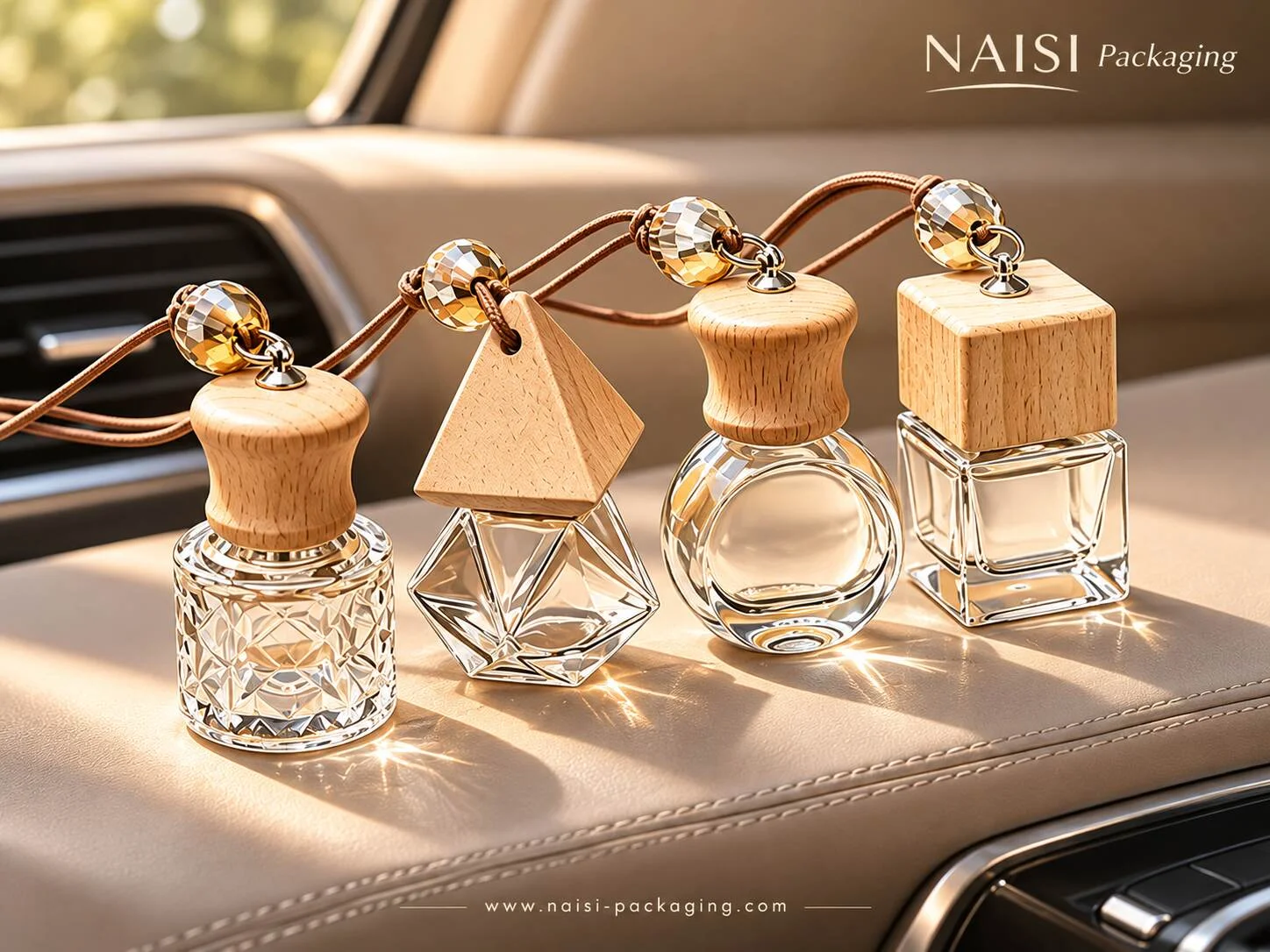
Design the Closure and Mounting System as One Assembly
For hanging car fragrance packaging, the cap is not only a visual accessory. It may support the suspension system, control exposure to the fragrance and connect the glass to other functional parts.
Separate Shipping Seal From In-Use Diffusion
A transport plug or sealed inner closure can help prevent liquid escape before use. A porous wooden cap or other diffusion element, by contrast, may be designed to absorb or release fragrance when activated. Those are different operating states.
A wooden cap is not automatically leakproof. If shipping uses a removable stopper, document the activation steps and allowable orientation. Specify membrane or wick systems separately.
The correct decision depends on the actual fragrance liquid, its volatility, the cap construction and the user experience. Alcohol-based and oil-based formulations may behave differently with liners, adhesives, wood and plastics. The formula owner and packaging suppliers should confirm compatibility using the intended formulation.
Put the Hanging Attachment in a Suitable Component
For hanging designs, put the cord attachment in a purpose-designed cap, collar or holder when feasible. Drilling finished glass introduces strength concerns and is not a casual customization option.
Review the cap's attachment feature, cord material, knot or fastener, edge finish and the way the load transfers into the bottle neck. The mounting point should remain secure during ordinary vehicle movement; it also needs to resist repeated handling during installation and removal.
Avoid promising that a rearview-mirror position is universally permitted. Items in the driver's sightline can create an obstruction, and requirements differ by market. The package instructions should specify only appropriate, legally permitted locations that do not interfere with visibility, airbags, controls or occupants.
Vent Clips and Stationary Holders Need Different Checks
A vent clip must fit the intended vent style without overloading louvers, blocking controls or placing glass in an unsuitable hot-air stream.
For a freestanding or holder-based concept, evaluate the holder, restraint and usable vehicle location together. Do not present an unsecured glass bottle on a dashboard as an acceptable default: sudden stops, sunlight and surface contact create additional risks.
Plan for Heat, Movement and Leakage From the Beginning
A parked vehicle can reach temperatures far above the outdoor air. Research on parked-car cabin temperatures confirms that heat buildup is significant and varies with weather and sunlight. That makes car interiors a different environment from a bedroom diffuser or ordinary perfume display.
The glass itself is only one part of the package. Elevated temperatures may change vapor pressure, evaporation rate, closure fit or the behavior of certain seals, coatings and adhesives. Some fragrance liquids can also affect vehicle plastics and finished surfaces if they spill. A visually perfect closure does not prove that the assembled diffuser will remain suitable under these conditions.
Agree on the conditions that represent the intended markets and use. The fill level and headspace deserve particular attention: liquid expansion and vapor buildup in a closed container can change the load on the seal when temperatures rise. Avoid setting a universal fill line from a photograph. The filler and closure supplier should confirm the actual capacity, intended fill volume and sealing arrangement for the formulation.
Also distinguish a sealed retail unit from a diffuser activated by the consumer; both need evaluation, but their acceptable behavior may be different.
Test the filled package with the actual fragrance formula where appropriate, including:
Orientation and movement: Upright use, foreseeable tilting, shaking, vibration and the transport configuration.
Closure integrity: Neck fit, plug retention, cap security and leakage or seepage after temperature exposure.
Materials: Compatibility of the liquid with seals, wood, cord, coatings, adhesives and any mounting component.
Appearance: Whether decoration, metal finishes or printed markings remain acceptable after relevant exposure.
User contact: Whether the bottle or attachment could strike, scratch or spill onto nearby vehicle surfaces.
Do not copy a generic "heat resistant" temperature or leak-test duration into every project. Appropriate conditions and pass criteria should be defined with the formulation and product-development teams for the destination market. Flammability information and consumer warnings should also reflect the actual fragrance formulation and applicable requirements.
A first sample may establish appearance; production-representative filled assemblies are needed for meaningful functional evaluation.
For general packaging-interface issues, our cosmetic bottle leakage guide explains why closures and transport configuration need to be considered together. Car fragrance adds its own heat, mounting and in-use requirements.
Make the Miniature Bottle Work on the Retail Shelf
Compact glass does not leave much room for storytelling. The outer pack therefore carries more responsibility than it does for many larger beauty products.
A single-bottle carton can carry usage details while protecting the glass. A display card improves shelf visibility but may not provide adequate protection. A gift box suits paired scents if its insert restrains the bottles.
A two-scent collection can reuse the same bottle silhouette, cap design and typography while distinguishing fragrances through controlled color accents. If a refill is offered, confirm the refill closure, filling method and compatibility of the reused diffuser components. Refill packs and open-use diffusers may need different seals and instructions.
Keep one recognizable bottle shape, a coordinated cap finish and consistent graphics across scents and bundles.
Show How the Product Is Used
The consumer should not need to guess whether a stopper must be removed, whether a wooden diffuser needs activation, or where the product may be mounted.
Include clear instructions and relevant warnings based on the actual design and selling market. Do not hide safety-critical information for aesthetics.
A Development Checklist for Brand and Packaging Teams
Start an inquiry with a short brief; do not send only a photograph of a miniature perfume bottle.
|
Brand provides |
Supplier or product team confirms |
|
Intended placement: hanging, vent clip or holder |
Compatible attachment concept and bottle geometry |
|
Fragrance type, target fill and destination market |
Closure and contact-material suitability |
|
Preferred bottle reference and finish |
Existing-mold options, dimensions, glass weight and decoration feasibility |
|
Cap, cord, clip or holder concept |
Assembly fit, attachment security and user-access considerations |
|
Retail format and number of scents |
Carton/insert arrangement and artwork space |
|
Expected quantities and timeline |
Sampling, possible tooling and customization requirements |
A practical sequence is to select the use format, shortlist existing glass shapes, confirm the closure and mounting concept, then sample the fully assembled pack. Review branded artwork only after the physical dimensions and visible surfaces are clear. Complete appropriate filled-product evaluations before approving a commercial order.
Keep three decisions separate: visual sample approval, component fit approval and the finished fragrance product's suitability for intended vehicle use. One cannot stand in for the others.
Frequently Asked Questions
Is a small perfume bottle suitable for a hanging car diffuser?
Not automatically. It may provide a useful starting shape, but the neck, cap, total weight, mounting arrangement, fragrance-release method and intended car environment still require review.
Does a wooden cap make a car fragrance bottle leakproof?
No. A porous wood component can be part of a fragrance-release system, but shipping seals and in-use diffusion are different functions. Evaluate the actual cap, stopper or membrane and filled bottle together.
Can the same glass bottle be sold as both a hanging and vent-clip product?
Possibly, if suitable separate attachments can be developed and each assembled version is evaluated. A common glass body does not prove that both mounting systems are secure.
Develop Compact Car Fragrance Glass Packaging With NAISI
Strong car fragrance glass bottle design balances a recognizable miniature silhouette with the closure, mounting arrangement, leakage control and retail presentation that the product actually needs.
NAISI Packaging supplies glass fragrance packaging and offers glass decoration and customization options. These designs offer starting points; car-use suitability and mounting solutions require project-specific confirmation.
Share your preferred bottle reference, fragrance type, target fill, intended mounting method, cap concept, artwork and estimated quantity. We can discuss suitable glass packaging and customization possibilities for your car-fragrance project.
WhatsApp: +86 189 2275 3052
Email: naisipackaging@gmail.com
Website: www.naisi-packaging.com