Deutsch
 English
 日本語
 한국어
 العربية
 Русский
 Türkçe
 Português
 Français

Neue SKUs in eine bestehende Hautpflegeverpackungslinie aufnehmen: Eine Checkliste für die Designentwicklung
Your 30 mL serum has sold successfully for two years, and the packaging has been reordered several times. Now a 120 mL toner, 100 mL lotion, 50 g face cream and 15 g eye cream are joining the range. Yet the current serum bottle may differ from the first approved sample.
Which version should the new products match? Which parts can actually be reused?
A skincare packaging line extension starts by resolving those questions, not by selecting a jar that looks similar in a catalogue. This guide shows what to reuse, recheck and approve when adding SKUs to an established range.
Establish the Right Reference Before Choosing New Containers
The original launch rendering is not enough. Start with the current controlled records.
Collect the latest approved bottle drawing, artwork revision, color and finish references, closure specifications and retained approval sample. Add a recent production unit, if available, along with records of changes made since launch. The pump, coating or logo placement may have been revised during repeat orders.
Compare the retained sample with the current production unit. If they differ, do not automatically treat the newest bottle as the design standard. The retained sample may have aged, or production may have shifted. The brand and supplier should identify the valid approved specification and resolve any differences before the extension proceeds.
Then define what carries forward: typography, palette, finish and visible closure character—not individual bottle dimensions or dispensing functions. For example, if the cap changed from matte to glossy after launch, establish whether this was an approved brand update or an unintended production difference before matching the new products.
If the existing documentation is incomplete, our skincare packaging design specifications guide explains how to organize those requirements. For an extension, the task is to recover and apply an established standard, not build a new one from zero.
Decide What to Reuse—and What Needs a New Approval
Separate visual reuse from physical component reuse. They are different purchasing decisions.
Charcoal lettering, ivory coating and metallic accents can carry across products, but their printed dimensions and finished appearance need evaluating on new parts.
A pump or cap is different. Matching color does not mean matching function. Even when two glass bottles use a similar neck finish, a pump must suit the new bottle depth, intended dose, dip-tube length, formula viscosity and materials in contact with the product. Caps and inner covers need appropriate seating, sealing and removal characteristics. A component approved for the serum is not automatically approved for a lotion or toner.
Ask whether the supplier has related capacities; similar bottles do not guarantee interchangeable closures. If the original bottle uses a proprietary mold or cap, check who controls the tooling and whether another capacity is actually available. Recreating a similar silhouette may be more practical than assuming an exact scaled version can be ordered.
There is also a purchasing distinction: reusing design references does not necessarily eliminate new sampling, print setup costs or minimum order quantities. A different container or artwork may need a separate quote. Confirm which parts, tooling or decoration setups can actually be shared.
Put Every New SKU in One Extension Matrix
One comparison sheet should show approved references, reusable elements and open decisions.
SKU | Keep from the established range | Confirm for this product | Status |
30 mL serum — existing | Current approved glass, logo and finish references | Verify latest production version against approved baseline | Reference to confirm |
120 mL toner — new | Ivory appearance, charcoal typography, brand hierarchy | Bottle geometry, dispensing option, artwork placement | Pending |
100 mL lotion — new | Common color and visible closure direction | Pump output, dip tube, finish matching and compatibility | Pending |
50 g cream — new | Color palette and logo identity | Jar capacity, cap/inner cover, printable area, fill suitability | Pending |
15 g eye cream — new | Typography and family appearance | Small-format artwork, jar/closure fit and access | Pending |
Illustrative project only. These are not confirmed NAISI stock combinations or product specifications.
Use supplier model references, artwork revisions and sample IDs where available. Mark decisions Proposed, Supplier-confirmed or Approved.
An eye cream jar can retain the serum's typeface while requiring smaller artwork and a separate print trial.
Match the Appearance on Real Bottles and Jars
New components may come from different molds or finishing runs. Mold differences do not automatically cause color variation, but glass thickness, shape, coating and texture can alter appearance.
Color and Finish
Compare the new parts with the agreed physical reference under consistent viewing conditions. Evaluate hue, opacity, gloss, texture and, where relevant, metallic reflectivity. A matte ivory coating on clear glass can look different from a similar coating on an opaque-looking jar; a champagne-colored plastic pump may not match a metallized jar cap without adjustment.
Pantone communicates intent but cannot replace physical approval. Agree on appropriate measurement methods and tolerances where needed.
Logo and Layout
Keep the brand's visual hierarchy, not identical artwork dimensions. A 120 mL toner bottle and a 15 g eye cream jar need separate placements in millimeters, approved printable areas and readable net-content information. Compare the finished packs from their intended front view; a logo that is centered in a flat artwork file may not appear balanced on a curved container.
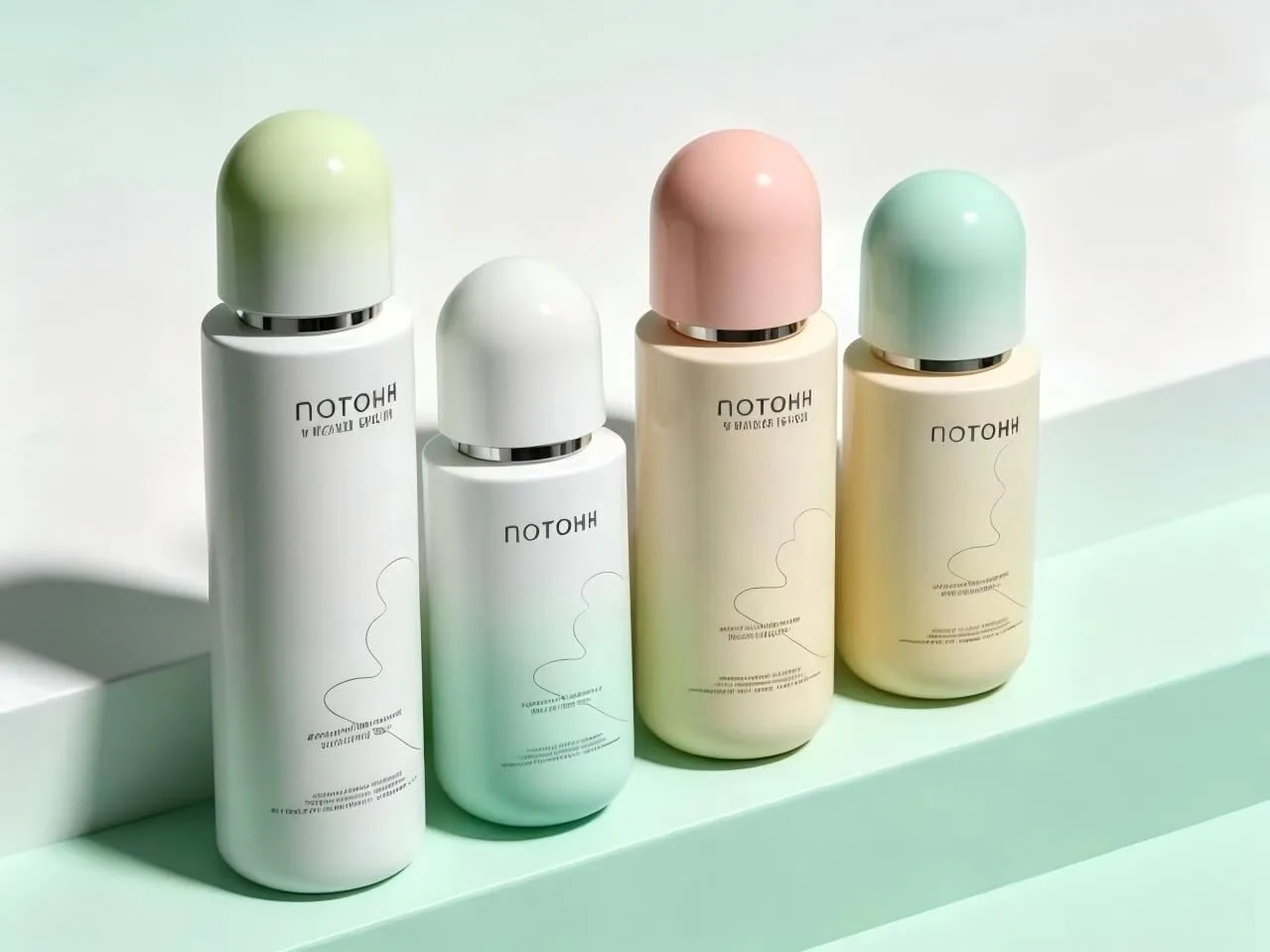
Compare the assembled range; mismatches are easy to miss when parts are approved separately.
Approve New SKUs Against Both the Original Standard and Current Production
For a mature range, sample approval needs three reference points: the agreed master standard, a representative current production unit and the proposed new SKU.
After reconciling the references, check each new pack for filling access, closure fit, dispensing and formula compatibility. Compare decorated samples together. Arrange the master reference, current serum and proposed new SKUs under the same agreed lighting. Review them both individually and as a complete range; record which mismatch requires a color adjustment, artwork change or a different closure finish.
If the new toner looks closer to today's serum than to the formally approved ivory reference, do not silently change the target. Decide whether the existing specification needs an authorized update or the new component needs adjustment. Document that decision for every affected SKU.
Where appropriate, run a preproduction trial. Before commercial production, agree on physical samples, artwork versions and appearance criteria. A photograph may document decisions, but it should not replace the approved physical reference where finish and color are critical.
For repeat orders, each SKU needs its own approved component and finish references, linked to the shared collection rules. Later batches should be compared with those agreed standards; sample approval for the new launch should not be the last time consistency is reviewed. For background on appearance variation, read Why Packaging Samples Can Look Different from Mass Production.
Skincare Packaging Line Extension Checklist
Before requesting samples or issuing an order, check that the team can answer these questions:
Have we identified the current approved design reference and compared it with a recent production unit?
Which visual rules can remain unchanged, and which artwork dimensions need adapting?
Can the required capacities come from an existing bottle or jar family?
Are proposed shared pumps, caps and inserts actually compatible with each new product?
Have new sample, decoration and MOQ implications been confirmed with the supplier?
Have glass finishes, closure colors and logos been compared on assembled packages?
Are every SKU's outstanding decisions and approvals recorded?
Is there a clear reference for later repeat orders, not just the first launch?
This catches missing decisions; it does not replace drawings or product-specific validation.
Frequently Asked Questions
Do all new SKUs need exactly the same bottle shape?
No. Containers may share proportions, finishes and branding but require different shapes and closures for their products.
Can a pump already used on our serum be reused for a new lotion?
Possibly, after checking fit, dosage, dip-tube length, formula behavior and material compatibility.
Which sample should we use if the original approved serum and current stock look different?
Review the specification and change history against retained and current samples. Confirm the valid reference before approving new SKUs.
Extend Your Existing Skincare Range With NAISI Packaging
A successful skincare packaging line extension preserves familiar design cues while choosing functional containers and closures for new products.
NAISI Packaging offers coordinated cosmetic glass bottle sets, glass serum bottles, glass cream jars and related decoration options for skincare brands.
Adding a toner, lotion, cream or eye treatment to your range? Share your existing packaging reference, new product types, capacities, finish preferences and estimated quantities. We can discuss suitable glass containers, matching accessories and customization options for your next launch.
WhatsApp: +86 189 2275 3052
Email: naisipackaging@gmail.com
Website: www.naisi-packaging.com