日本語
 English
 Deutsch
 한국어
 العربية
 Русский
 Türkçe
 Português
 Français

ガラスクリームジャーのデザイン:口径、中蓋、キャップが容器開発に与える影響
A skincare brand approves a glass cream jar because its proportions look right. Then the packaging samples arrive: the filling nozzle has limited access, the inner lid sits too low, or the outer cap does not close smoothly.
The jar was chosen by appearance before its opening and closures were reviewed together.
For a new glass cream jar design, brands should confirm these structural relationships before committing to custom tooling. Here is what to specify, ask a manufacturer and verify with samples.
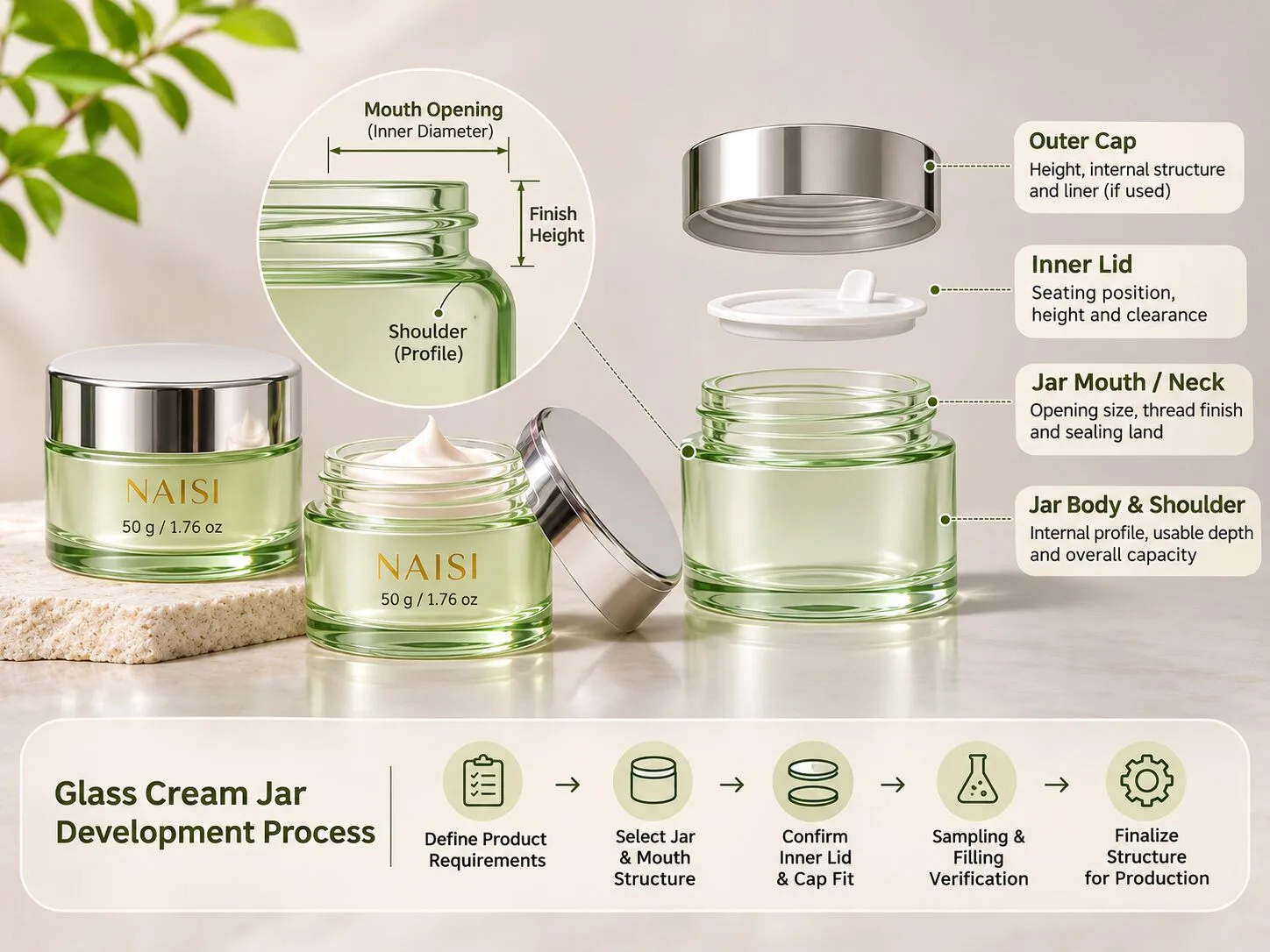
Jar Mouth Dimensions: Start With the Opening
Two glass jars can have the same outside diameter and different usable openings. The neck finish and shape below the rim affect filling and closure fit.
A photograph cannot show these details. Request a dimensioned drawing that identifies:
Clear inner opening: The available space for a filling nozzle and for reaching the product.
Neck and thread dimensions: The geometry the outer screw cap must match.
Rim or sealing land: The contact area for a liner or another intended sealing part.
Neck-finish height: A dimension affecting thread engagement and the cap's final seated position.
Critical tolerances: The supplier-confirmed dimensional variation that the mating parts must accommodate.
A wider opening may make filling and product access easier, but it does not automatically make the jar more prone to leakage. Sealing depends on the actual contact surfaces and closure design. A narrower opening does not necessarily use less glass either.
If you are still deciding between different fill sizes, see our Glass Cream Jar Capacity Guide. Capacity and net content are different.
When Does the Shoulder Affect Inner-Lid Fit?
The important detail is the internal shoulder profile, not just the rounded or straight appearance seen from outside.
A disc supported entirely by the top rim may never contact the shoulder. A recessed inner cover, however, may extend below the opening and encounter a narrower internal section. Whether the shoulder matters therefore depends on where the cover seats and how far it projects into the jar.
Consider a hypothetical 50 g cream project using a low, rounded-shoulder jar. The brand chooses a recessed inner lid to match its desired opening experience. During drawing review, the supplier finds that the insert would interfere with the inner shoulder. The brand can compare a different insert, an existing jar with more internal clearance, or a revised profile for a custom mold. Check these options before tooling.
Decision: Confirm the clear opening, internal cross-section and intended inner-cover position together—not as three separate choices.
Inner-Lid Clearance: Allow Space for Installation and Use
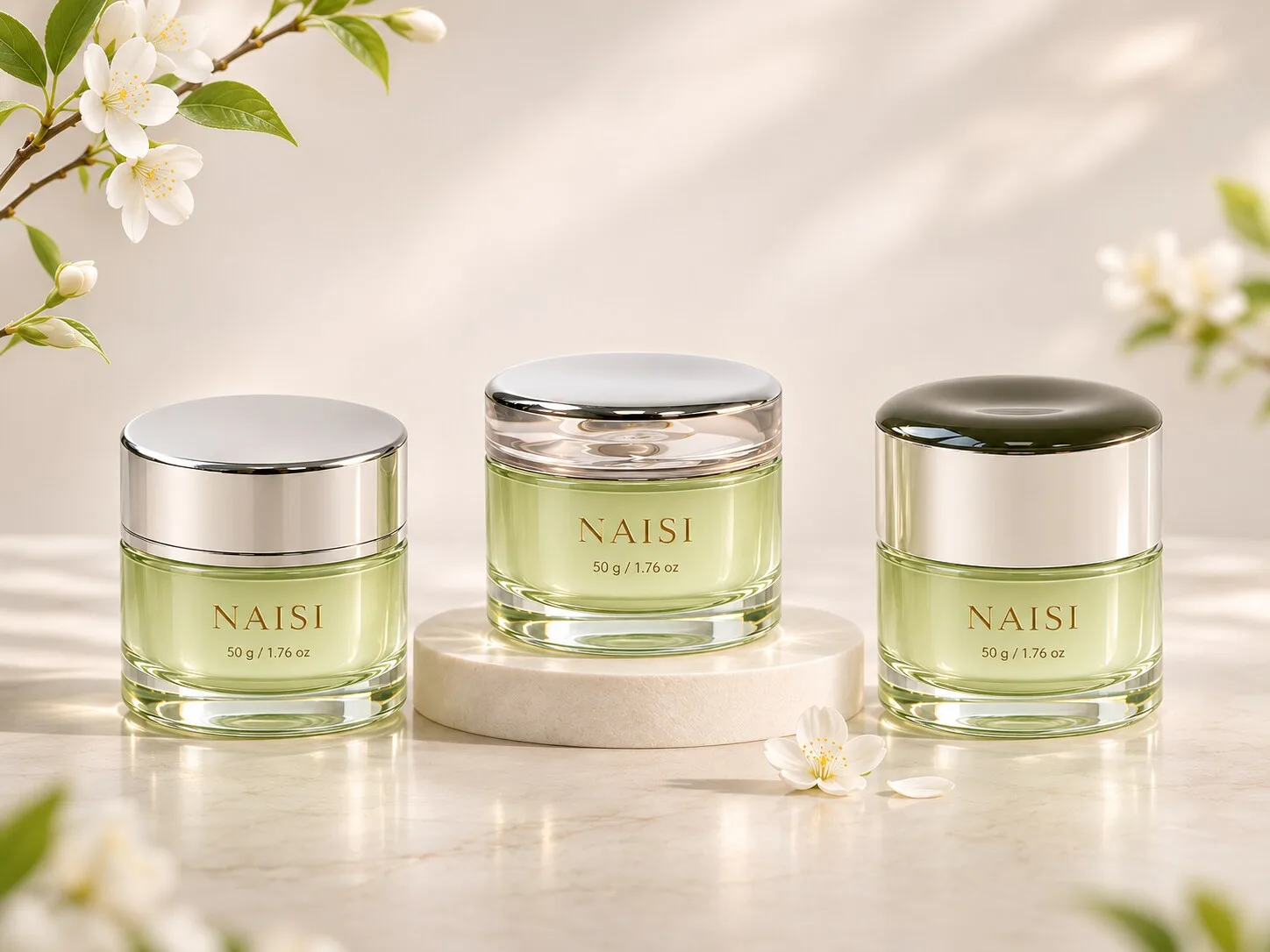
Here, inner lid means the removable disc or cover beneath the outer cap. It is not necessarily the same as the liner or gasket that provides the primary seal.
An inner lid may fit an empty jar yet interfere with the cream. Check the surface on which it rests, its installed height, the lowest point of its underside and the space needed to grip its tab.
Then compare those dimensions with the highest expected product level. Confirm net fill, formula characteristics and headspace with the filler. A 50 g net fill is a weight, not proof that a 50 mL jar will be suitable. Density, usable capacity and filling behavior must be considered.
How the cover locates is equally important. A loose rim-supported disc, a press-fit insert and a snap-retained cover need different mating features. A retained part may be sensitive to variation in glass dimensions and the insert material. Suppliers must confirm fit, installation and removal effort.
For a series of 15 g, 30 g and 50 g products, a shared neck finish may allow some jars to use the same inner cover. Do not assume compatibility. Each jar still needs its own clearance and assembly checks.
For the functions of removable inner discs, see our separate article, Why Does a Cosmetic Jar Need an Inner Lid?.
Decision: Record the inner cover's seating position and clearance on the jar drawing before treating it as an approved accessory.
Outer Cap Design: Check Fit Before Finalizing Height
A tall cap can make a low glass jar feel more substantial, while a shallow cap may support a minimalist design. Either can work if its internal geometry matches the jar.
For a screw cap, the supplier should review the threads, engagement depth, cap skirt, final seated position and any internal liner. A cap that screws on is not necessarily well matched. It should close consistently without cross-threading or unwanted contact with the inner disc.
If the cap has a liner, check whether it reaches the intended rim surface when the cap is fully seated. Internal ribs and retaining features should have a clear purpose; decorative coatings must not interfere with functional contact areas.
During sampling, confirm two different questions:
Closing performance: Can the cap be tightened consistently using the intended packing method?
Opening experience: Can a customer grip, open, remove the inner cover and reclose it comfortably?
If the filling process requires controlled tightening, the cap supplier and filler should agree on suitable application settings and checks for that specific assembly. A universal torque value should not be copied from another jar.
Consider cap weight as well as height. Balance depends on the filled jar, base and cap material. Judge it with real samples on a level surface and during ordinary handling—not from a rendering.
Decision: Approve the cap's internal fit and handling experience alongside its appearance.
Sealing: Identify the Actual Contact Surface
A removable inner disc, cap liner and gasket are different components. Before deciding whether a design needs one or several of them, identify which part is intended to form the primary seal.
Closure arrangement | Main design question |
Removable inner cover | Does it simply cover the product, or is it designed to seal against a defined surface? |
Cap liner or gasket | Which part of the glass rim is contacted or compressed when the cap is closed? |
Inner cover plus liner | Is there enough clearance for both without disturbing cap seating? |
The arrangement depends on the formula and package. A low-viscosity cream may behave differently from a thick balm during transport. Ingredients may also interact with plastic inserts, cap liners or coatings.
The Cosmetics Europe Guidelines on Stability Testing of Cosmetic Products discuss compatibility between the cosmetic formula, container and external environment. The guidance supports evaluating a package representative of the product to be marketed; it does not prescribe one seal or a universal leakage-test limit for glass cream jars.
Filling temperature also matters. Many conventional cream emulsions are cooled before filling, whereas some wax-rich balms may be poured warm or hot. If elevated-temperature filling is planned, confirm the jar and closure materials are suitable for the actual filling and cooling conditions with the relevant suppliers. This check applies only when needed.
For transport, evaluate the filled and closed package under conditions relevant to the intended distribution route. A tight-feeling empty jar proves little about leakage.
Decision: Agree on the intended sealing interface and product-specific checks before approving the complete closure arrangement.
Validate the Structure With a Supplier-Ready Checklist
The brand communicates product needs; the glass, cap and filling partners confirm dimensions and fit.
This short checklist separates core structural information from conditional checks:
What to confirm | Who provides or verifies it | When needed |
Product net content, formula type and intended use | Brand / formulator / filler | Every project |
Clear mouth opening, rim and neck-finish drawing | Glass supplier, checked with cap supplier | Every project |
Internal shoulder profile and usable capacity | Glass supplier | Every project |
Inner-cover seat, lowest point and removal clearance | Glass and insert suppliers | When using an inner cover |
Cap engagement, liner fit and seated position | Glass and cap suppliers | Every project |
Filling nozzle access, final fill level and headspace | Filler with packaging suppliers | Every project |
Filling-temperature suitability | Filler and packaging suppliers | When elevated-temperature filling is planned |
Seal performance, assembly and transport checks | Relevant project parties | According to the package and distribution conditions |
Use Proposed, Supplier-confirmed and Approved statuses in the project record. A proposed dimension from an artwork drawing should not become a production acceptance limit without confirmation.
A Practical Sampling Sequence
Start with an existing jar or representative component set where possible. This helps assess opening access, inner-disc handling and general cap proportions before investing in a custom mold. For a new shape, review the technical drawings and intended interfaces before tooling; final performance can only be verified with representative physical parts.
Run a filling trial using the intended product and equipment. Check nozzle clearance, rim cleanliness, product level and inner-lid installation. Then assemble and open the closure repeatedly, looking for thread issues, interference, difficult removal or inconsistent seating.
Finally, review the filled package for the agreed storage and shipping conditions. For a family of jar sizes, repeat the relevant fit checks on each size, even when the design language and closure appearance are shared.
Record the sample version, the issue found, the change made and the approval decision. This helps prevent outdated components from being reused.
Before Committing to a Custom Glass Jar Mold
Work in a clear order: define the formula and filling needs; shortlist an opening and jar profile; check the inner cover, cap and sealing contact together; then review drawings and available samples before finalizing a tooling proposal. After representative samples are made, complete the applicable filling, assembly and performance checks before authorizing mass production.
The process is collaborative. The brand sets the requirements; the manufacturer and other relevant suppliers confirm what the selected components can deliver.
Frequently Asked Questions
Can 30 g and 50 g glass cream jars use the same cap?
Possibly, if the neck finish, thread engagement and sealing surface are compatible. Similar exterior proportions alone cannot confirm fit. Check drawings and assembled samples for each capacity.
Does every glass cream jar need an inner lid?
Not necessarily. The package must meet its defined product protection, user experience and sealing requirements, but those requirements can be achieved with different closure arrangements. Select an inner cover according to the actual package design.
Can I choose a glass jar before the cream formula is finalized?
You can shortlist existing styles and review preliminary closure choices. Final fill level, material compatibility, sealing and filling conditions should be confirmed using the intended formulation and complete packaging system.
Develop Your Glass Cream Jar and Closure Set With NAISI
Good glass cream jar design starts with an attractive container and a compatible closure system. Jar-mouth dimensions, inner-cover position, cap fit and filling requirements are easier to coordinate while the packaging selection is still flexible.
NAISI Packaging supplies custom glass cream jars and matching lid options, along with decoration and customization options for skincare brands. Share your desired shape, target net content, reference images, preferred closure and estimated order quantity. We can discuss available glass jar styles and suitable accessory options for your project.
WhatsApp: +86 189 2275 3052
Email: naisipackaging@gmail.com
Website: www.naisi-packaging.com