Português
 English
 日本語
日本語 Deutsch
 한국어
한국어 العربية
 Русский
 Türkçe
 Français
Cosmetic Bottle Leakage in Transit: Pumps, Closures and Seal Validation
A serum bottle can leave the filling line in perfect condition and still arrive at the customer's door with product around the pump.
For an ecommerce beauty brand, that difference matters.
Parcel distribution exposes packaged products to repeated handling, changing orientation, vibration, shock and compression. ISTA Procedure 3A is specifically designed for individual packaged products up to 70 kg moving through parcel delivery systems. ISTA Project 3L addresses a different route, generalized ecommerce retailer fulfillment from the retailer fulfillment operation through delivery to the consumer.
This makes cosmetic bottle leakage more than a logistics question.
The cause often sits somewhere in the interaction between the bottle neck, pump or closure, sealing interface, formula, assembly process and secondary packaging.
A suitable bottle therefore needs more than an attractive shape.
For procurement teams, the useful question is:
Will the final filled and assembled package maintain its seal and function after the distribution conditions expected for this sales channel?
Answering that question before mass production creates a much stronger ecommerce packaging project.
The Most Common Ecommerce Packaging Failure Causes
Accidental Pump Actuation
A pump designed for convenient daily dispensing can experience very different mechanical loads inside a parcel.
Pressure from an insert or retail carton may reach the actuator. The package may also change orientation repeatedly during handling.
A locking pump can help keep the actuator in a secured position.
Current component development reflects this need. Aptar Beauty's PZ Twist uses a twist to lock mechanism and is marketed for ecommerce applications. The system can operate without a separate overcap. Aptar also makes an important qualification: its ISTA 6 Overbox test results may vary according to container shape, container size and sample formula.
The practical lesson is clear.
A pump supplier's test history provides useful technical evidence for the component. The brand still needs to evaluate that pump on the intended bottle and with the actual packaging configuration.
Neck Finish and Closure Mismatch
A secure seal starts with the correct interface.
For many skincare packages, continuous thread finishes such as 18/410, 20/410, 24/410 and 28/410 are commonly used. Matching the nominal neck size alone is only the starting point.
DWK Life Sciences explains that neck finish performance depends on dimensions including T, E and H. Two bottles described with a similar nominal neck diameter can use different thread geometries or finish heights, which affects closure engagement and sealing.
A pump specified for a 24/410 finish should therefore be evaluated with a bottle manufactured to the corresponding 24/410 neck specification.
Final sealing performance also depends on the sealing surface, gasket or liner design, component tolerances and application conditions.
Fragrance packaging requires another distinction.
CETIE publishes SNI screw neck specifications specifically for perfume and cosmetic glass bottles. SNI finishes belong to a different technical system from the 410 continuous thread finishes widely used in skincare dispensing.
That distinction matters when a buyer sources bottles and dispensing components from different suppliers.
Dip Tube Position
Dip tube length is often included in leakage discussions, although its main technical role is dispensing performance and product evacuation.
An overly long tube may bend, curl or press its inlet against the bottle base. A short tube can begin drawing air while usable product remains below the pickup point.
These are real packaging issues.
They are better treated as dispensing and product evacuation concerns rather than primary leakage controls.
Transit leakage deserves closer attention to the neck finish, sealing interface, pump architecture, closure application and actuator protection.
For development, size the dip tube using the real internal bottle geometry. Thick glass bases, curved bottoms and raised internal profiles can all change the usable depth.
Then test the assembled dispenser with the intended formula.
This keeps dip tube optimization and seal validation as two connected but separate engineering tasks.
Insufficient Bottle Restraint
Glass bottle protection also depends on how the product sits inside its secondary packaging.
A tall serum bottle and a low, wide cream product distribute forces differently. A perfume bottle with a substantial cap can create another center of gravity.
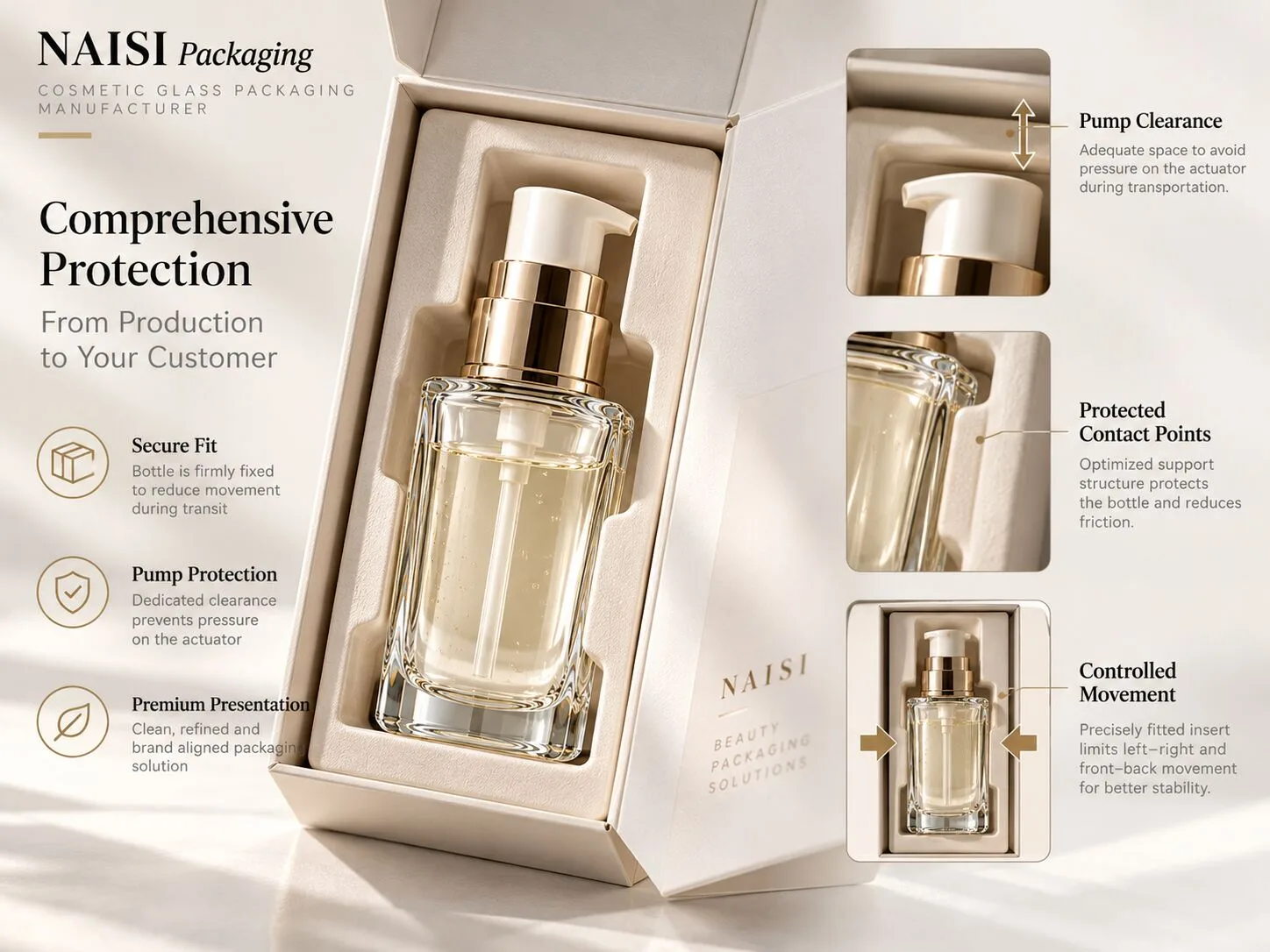
The insert needs to control movement while providing suitable clearance around the closure and actuator.
Excessive free movement allows the bottle to gain momentum before an impact. At the same time, concentrated pressure from a poorly positioned insert can transfer force into the shoulder, pump or decorated surface.
ISTA's test methods evaluate the packaged product, reflecting the fact that transport performance depends on the relationship between product and packaging rather than either component alone.
For ecommerce glass packaging, fit, contact points and load distribution deserve as much attention as the insert material itself.
Assembly Variation
A technically suitable bottle and pump still require controlled assembly.
For screw closures, application conditions influence the final interface. The pump needs to seat correctly and the sealing element needs to remain in its intended position.
A crimp fragrance pump follows a different assembly process. CETIE publishes dedicated recommendations for crimping pumps with aluminium ferrules onto FEA glass finishes, illustrating why closure type and assembly method need to be treated together.
Production control should therefore be defined around the actual closure system.
Approved samples are useful, but mass production should ultimately be evaluated against agreed specifications and tolerances.
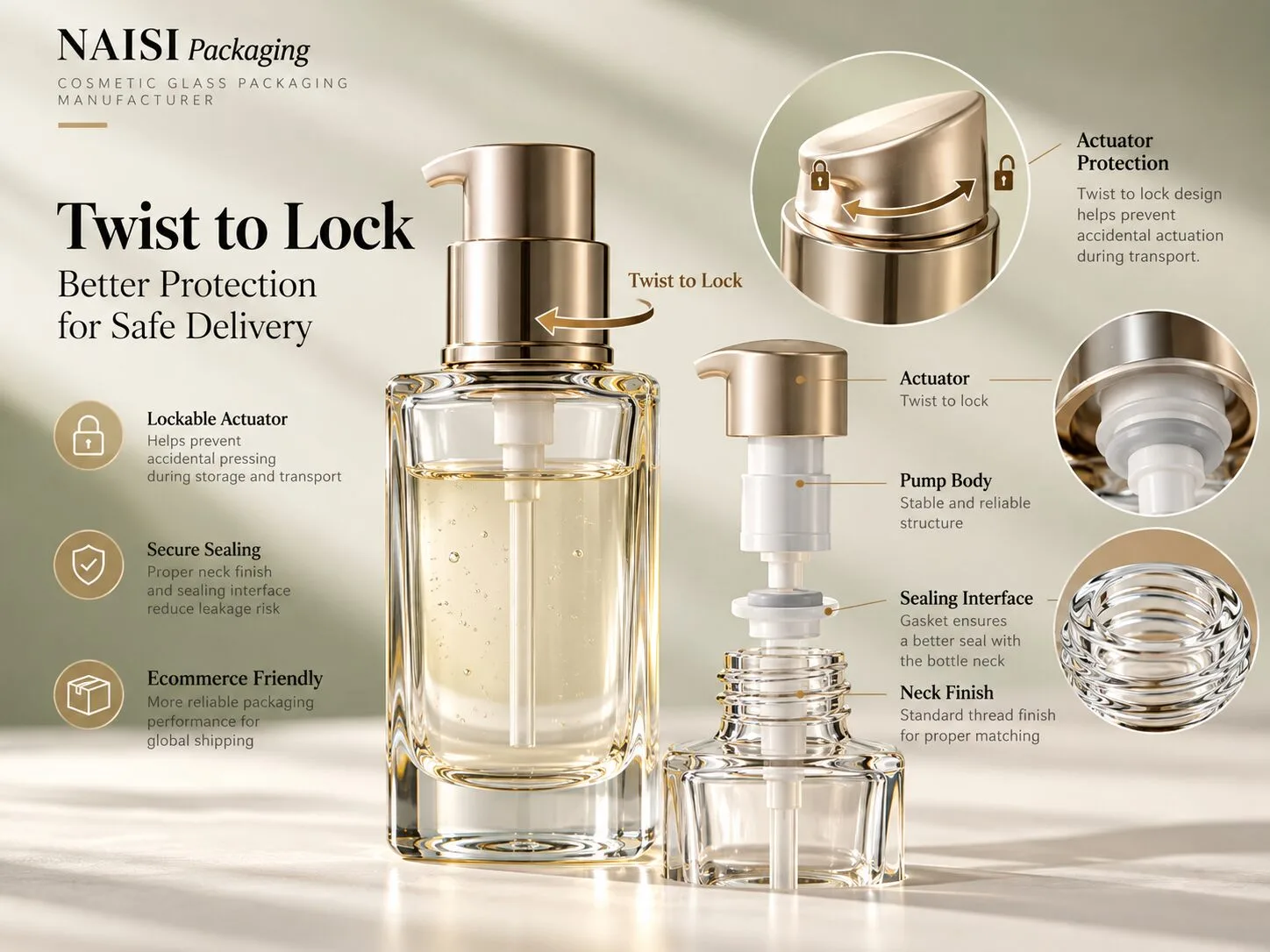
Core Solutions to Avoid Leakage & Shipping Damage
Consider a Locking Pump
For serum, lotion, hair care and other products sold online, a suitable locking mechanism can reduce accidental actuator movement during handling.
Twist to lock designs are one practical option.
Aptar's Novus Advance, released in September 2026, uses a twist to lock, cap free design. Aptar states that the pump passed its in house ISTA 6 Overbox testing and specifically notes that performance may vary depending on container shape, size and formula.
That qualification is exactly how brands should interpret an ecommerce capable pump.
It provides a stronger starting point. It does not replace validation of the final package.
Confirm the Full Neck Finish
Use the complete neck designation rather than diameter alone.
For a continuous thread package, confirm the nominal size and thread finish series. Review the technical drawing where possible.
Then assess the sealing interface.
The correct thread gets the components into the right mechanical relationship. The gasket, liner, sealing surface and assembly conditions determine how that interface performs in the completed package.
For screw closures, application conditions also deserve attention. Excessive or insufficient application torque can affect how a closure seats, so the production method should follow the component supplier's specification.
This is especially important when glass bottles and pumps come from different manufacturing sources.
Validate the Dip Tube Separately
Dip tube development should focus on reliable product pickup.
Use the bottle drawing together with a physical bottle sample. Confirm the internal depth and actual bottom geometry.
The inlet should reach an appropriate usable product area while maintaining a clear flow path.
A single universal bottom gap does not apply to every bottle, tube and pump design.
Evaluate near empty dispensing with the intended formula before finalizing the tube cutting specification.
This avoids mixing two different approval questions:
Does the pump evacuate the formula effectively?
and
Does the complete closure system remain sealed during distribution?
Each needs its own evidence.
Use a Relevant Transport Test
Internal leak screening is useful during development.
A team may use controlled inversion observations, vibration screening or repeated handling trials to identify obvious weaknesses. The method, duration and acceptance criteria should be defined for the project rather than treated as a universal industry standard.
Formal transport validation serves a different purpose.
ISTA Procedure 3A applies to individual parcel delivery packages up to 70 kg. In 2018, ISTA added a specific test block for packaged products containing liquids to evaluate the closure system's ability to contain the liquid after the other 3A test elements have been completed.
ISTA 3L is intended for packaged products moving through generalized ecommerce retailer fulfillment systems and includes hazards associated with retailer processing and delivery to the consumer.
The correct procedure depends on the actual fulfillment route.
Build Secondary Packaging Around the Finished Product
Develop the protective structure around the fully assembled bottle.
That means the final pump, cap, collar and decoration should be present.
A CAD drawing can establish dimensions, while a physical assembled sample reveals contact points, component clearance and actual weight distribution.
Paperboard, corrugated structures, molded pulp and foam can all be appropriate depending on the project.
Material selection matters. Restraint geometry, contact locations and load distribution are equally important.
A strong ecommerce package controls movement while keeping pressure away from sensitive dispensing components.
Brand Cost of Shipping Failures
Leakage affects more than the product inside one bottle.
A replacement creates additional fulfillment work, customer service activity and shipping expense. Escaped formula may also affect the retail carton or other products sharing the parcel.
Glass breakage brings another level of concern.
For a direct to consumer beauty brand, the delivered package may be the customer's first physical interaction with the product.
Its condition shapes the unboxing experience.
This makes cosmetic bottle seal integrity part of brand experience as well as packaging engineering.
For procurement teams, the same principle improves supplier communication.
Instead of asking:
“Is this pump leak proof?”
ask:
How is the pump secured during transport?
What neck finish does it require?
What sealing element is used?
How should the closure be applied?
What transport testing has been performed on this exact configuration?
These questions lead to more productive discussions with packaging suppliers because they focus on the complete system.
How NAISI Packaging Supports Ecommerce Shipping Projects
For NAISI Packaging, ecommerce packaging development begins with component compatibility.
We supply cosmetic glass bottles for skincare, fragrance and private Portuguese beauty projects and can coordinate pumps, droppers, sprayers and caps according to the selected bottle.
The bottle neck and dispensing component should be reviewed together before sampling.
Where a pump uses a dip tube, the cutting specification can be developed according to the actual bottle geometry and component requirements.
Locking pump options can also be considered where the mechanism suits the formula, bottle and intended consumer use.
The final assembled product then provides the basis for secondary packaging development.
For projects requiring formal transport qualification, the test procedure should follow the intended distribution environment. Formal testing should be carried out by an appropriate testing laboratory using the selected procedure.
This creates a clear distinction between component capability and complete package validation.
A pump may have its own ecommerce test history. The brand's finished bottle, formula, closure, retail packaging and shipping configuration still form the packaged product that ultimately travels through distribution.
NAISI Packaging can also support surface decoration including frosting, sandblasting, spray coating, silk screen printing and hot stamping.
For ecommerce projects, decoration should be considered during secondary packaging development because repeated contact with inserts can influence the appearance of certain finished surfaces.
Conclusion
Reducing cosmetic bottle leakage starts with understanding where sealing performance actually comes from.
The pump needs suitable protection from accidental actuation.
The bottle and closure need a correctly matched neck interface. The sealing element and assembly process need to function together. Dip tube length should support product evacuation, while secondary packaging controls movement and protects the assembled product.
Transport testing then evaluates how these decisions perform as one package.
For ecommerce beauty brands, that sequence is far more useful than treating leakage as a carrier problem after launch.
Use production representative components.
Fill the package with the intended formula, or an appropriate representative fill where suitable. Assemble the final closure and protective packaging. Then evaluate the complete packaged product under conditions that reflect the expected distribution route.
That process gives procurement teams clearer evidence and gives suppliers a better technical basis for solving problems before mass production.
NAISI Packaging supports stock and custom cosmetic glass bottle projects together with compatible dispensing components and surface decoration.
If you are developing a serum, lotion, skincare or fragrance package for online sales, share your bottle capacity, formula type, closure requirement, sales channel and expected quantity with our team.