العربية
 English
 日本語
日本語 Deutsch
 한국어
한국어 Русский
 Türkçe
 Português
 Français

Cosmetic Bottle Neck Finish Guide: 18/410, 20/410, 24/410 and 28/410 Explained
A 30 ml glass bottle and another 30 ml glass bottle can hold exactly the same amount of formula and still require completely different dispensing components.
The difference often begins at the neck.
Beauty brands naturally focus on bottle capacity, shape, color and decoration during sourcing. Yet the cosmetic bottle neck finish determines how the container connects with a pump, sprayer, screw cap or other closure.
A code such as 20/410 contains two important pieces of information.
The first number identifies the nominal neck size, based on the outside diameter across the threads known as the T dimension. It should be treated as a size designation rather than an instruction that every finished glass bottle must measure exactly 20.00 mm.
The second number identifies the finish series.
In the GPI and SPI continuous thread system, 410 refers to a defined thread and finish geometry. Industry technical references commonly describe the 410 series as a taller continuous thread finish with approximately one and a half turns, while 400 and 415 use different finish configurations.
This distinction becomes important when components come from different suppliers.
A closure described as 24/410 should be evaluated with a bottle produced to the corresponding 24/410 finish. Matching only the first number gives the buyer only part of the specification.
This guide breaks down 18/410, 20/410, 24/410 and 28/410 and explains how packaging teams can use these codes when sourcing cosmetic pumps, closures and glass bottles.
Core Concept: What Is Continuous Thread CT 410 Finish?
A continuous thread finish, commonly shortened to CT, uses a continuous helical thread around the neck of a container. A compatible closure screws onto that thread and engages with the sealing system of the package.
GPI publishes finish drawings for the 400, 410 and 415 families. CETIE currently hosts references to these official GPI finish drawings in its technical documentation library.
For a code such as 24/410:
24 identifies the nominal neck diameter family.
410 identifies the thread finish series.
The full code matters because neck diameter is only one part of the interface.
DWK Life Sciences explains that the GPI finish includes dimensional features such as the outer thread diameter and finish height, and that different thread series with the same nominal diameter have different geometry and sealing behavior.
400 vs 410 vs 415 Neck Finish
This is one of the most useful distinctions for cosmetic packaging buyers.
The 400, 410 and 415 families use different finish heights and thread engagement. DWK describes 400 as a shorter thread configuration, 410 as a taller profile with approximately 1.5 turns, and 415 as an extended finish.
For that reason:
24/400, 24/410 and 24/415 are three different neck finishes.
They share the same nominal diameter family, but they should be treated as separate component interfaces.
This is also why 410 should not be described as a universal DIN standard.
GPI and SPI finishes form one specification system. DIN and GL threads form another. DWK specifically notes that GPI and DIN/GL thread systems are dimensionally different and their closures are not interchangeable across the two systems.
For cosmetic sourcing, use terminology such as:
24/410 continuous thread finish
or
24/410 CT neck finish
This gives the pump or closure supplier a much clearer technical reference.
Bottle Neck Finish Dimensions
The T dimension is only the starting point.
A technical neck drawing can also include dimensions such as:
T: outside diameter across the threads
E: neck diameter below the threads
I: internal bore or opening
S: thread start position
H: overall finish height
These dimensions influence closure engagement, component clearance and sealing behavior. DWK highlights T, E and H as key dimensional elements when matching a screw closure to a container.
For everyday purchasing, the full finish code provides the first filter.
For tooling approval and mass production, the technical drawing and physical assembly become more important.
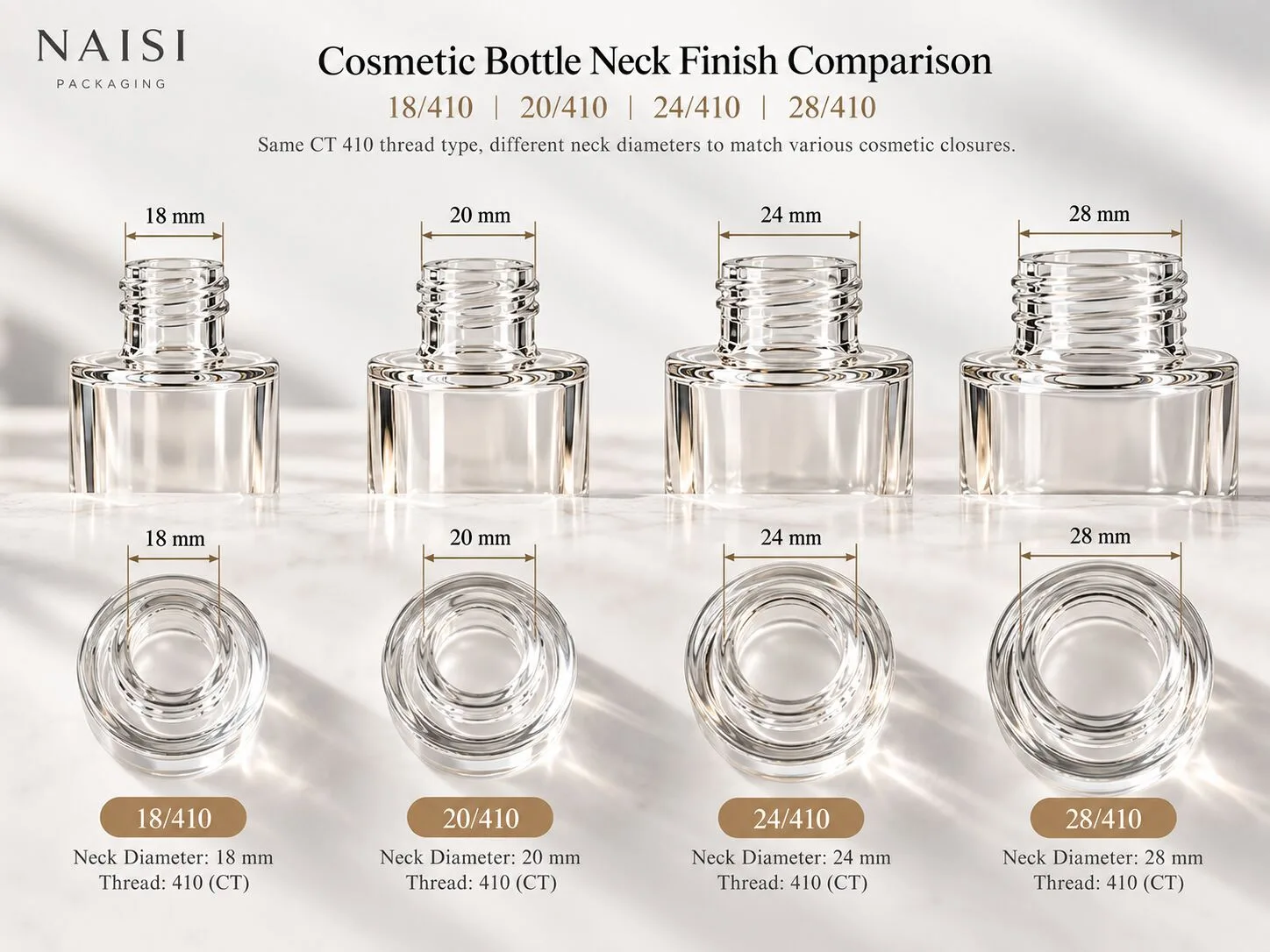
18/410, 20/410, 24/410 and 28/410 Explained
The four finishes belong to the same 410 family, while the increasing nominal diameter creates different opportunities for dispensing and closure systems.
Neck Finish | General Packaging Direction | Component Direction | Key Buyer Check |
18/410 | Compact bottles and smaller dispensing formats | Selected compact closures, sprayers and treatment components | Confirm exact supplier availability and full finish drawing |
20/410 | Skincare, treatment and personal care bottles | Selected pumps, sprayers, flip tops and screw closures | Confirm component finish, formula and dip tube requirements |
24/410 | Skincare, hair care, body care and treatment packaging | Cosmetic pumps, spray pumps, disc tops and flip tops | Confirm dosage, sealing and complete package compatibility |
28/410 | Larger personal care and body care formats | Larger dispensing pumps, disc tops and other closures | Confirm output, bottle geometry and final assembly |
These applications are sourcing directions rather than rigid industry rules. Component portfolios vary by supplier and region.
18/410 Neck Finish
The 18/410 neck finish is one of the smaller sizes within the GPI 410 family. GPI documentation includes 18 among the standard 410 sizes.
Its compact diameter can suit smaller bottles and dispensing formats where the supplier offers compatible components.
The important purchasing point is availability.
An 18 mm component may be manufactured in 18/400, 18/410, 18/415 or another configuration. A buyer should therefore request the complete finish specification rather than asking only for an “18 mm cap” or “18 mm dropper.”
This is especially important with droppers.
Dropper systems appear in several neck families, so a small glass serum bottle should be matched through the supplier drawing and complete closure specification.
The same caution applies to fragrance.
Fine fragrance bottles frequently use dedicated systems such as FEA crimp finishes or SNI screw necks. Bottle capacity alone does not identify the neck finish.
For an 18/410 project, start with the actual bottle drawing and then select the compatible dispensing component.
20/410 Neck Finish
The 20/410 neck finish creates more options across dispensing and closure portfolios.
Aptar currently lists 20/410 among the available neck finishes for components including its Mini Trigger Spray and Classic cylindrical closures.
For a skincare brand, this can support projects involving lighter treatment products, mists and other dispensing formats where a compatible 20/410 component is available.
The neck code establishes the mechanical interface.
It does not define the function of the dispenser.
Two pumps with the same 20/410 neck finish can still have different outputs, internal engines, dip tubes and formula compatibility.
This distinction is useful when buyers search 20/410 vs 24/410 neck finish.
The difference begins with neck diameter, while the final packaging decision should also consider the pump design, formula, bottle proportions and user experience.
For a 20/410 project, confirm:
the full neck specification, the selected dispensing component and the production representative assembly.
24/410 Neck Finish
The 24/410 neck finish has broad representation across current beauty and personal care dispensing portfolios.
Aptar currently offers multiple 24/410 solutions, including cosmetic pumps, spray pumps and disc top systems. Its Amplitude cosmetic pump, for example, uses a 24/410 finish, while PZ Nozzler and PZ Twist also use 24/410 for spray applications.
This illustrates an important sourcing lesson.
One neck finish can support several dispensing directions.
A brand might use 24/410 with a cosmetic pump for one product and a spray system for another, provided each complete bottle and component combination has been technically evaluated.
The neck size itself does not determine dosage.
Pump engine design determines output per actuation.
It also does not determine formula compatibility. Viscosity, rheology, formula contact materials and the dispenser structure remain separate technical considerations.
For glass projects, the actual GPI glass finish drawing and component drawing should be aligned before production.
Among NAISI Packaging projects, 24/410 is an important option for selected glass bottle programs where brands require a wider range of compatible dispensing components.
28/410 Neck Finish
The 28/410 neck finish is commonly found on larger dispensing systems.
Aptar's current GSA Luxe uses 28/410 with 1.2 cc and 2 cc dosage options. Its HD high dose pump also uses 28/410, while the Classic Disc Top portfolio includes a 28/410 configuration.
This makes 28/410 relevant for larger body care, lotion and personal care projects.
Again, diameter should not be used as a shortcut for pump output.
A 28/410 pump may deliver one dosage while another pump using the same neck finish delivers a different amount. Aptar's own portfolio demonstrates this variation across different pump engines.
For larger glass bottles, the assembled package also deserves attention.
Pump height, actuator size, bottle stability, dip tube specification and secondary packaging all influence the finished commercial pack.
The 28/410 code tells the buyer how the component connects to the neck. The rest of the package still requires its own engineering decisions.

Common Matching Pitfalls
Most neck finish problems begin before the components reach the filling line.
Matching Only the Diameter
A buyer sees “24 mm” on the bottle and selects a 24 mm pump.
The better purchasing question is:
Which 24 mm finish?
24/400, 24/410 and 24/415 belong to different thread configurations. DWK confirms that identical nominal diameters across different finish series do not automatically create compatible closures.
Always include the complete code on RFQs, technical drawings and component approval records.
Treating the Neck Code as the Complete Compatibility Test
Matching neck codes create the correct starting point.
Physical testing confirms the finished package.
Glass bottles are manufactured to defined dimensional tolerances, while pumps and closures also have their own component specifications. The sealing design, liner or gasket, thread engagement and application conditions all contribute to final performance.
Use production representative samples to check assembly.
Review how the closure seats on the glass. Check visual alignment and pump operation. Filled samples can then be evaluated for leakage, formula compatibility and expected distribution conditions.
Ignoring the Bottle Bore
The external thread is only one part of the neck.
The internal bore can affect the fit of pump stems, reducer components and other internal elements. This is why the I dimension appears on technical neck drawings.
When matching components from different suppliers, share the complete bottle drawing whenever possible.
Changing the Neck Finish Late in Custom Development
For a custom glass bottle, the neck finish influences tooling and every component attached to that neck.
Moving from one finish to another can change the pump or cap specification, dip tube requirement, sampling process and tooling scope. Production minimums may also change according to the supplier and project.
Selecting the dispensing system early creates a smoother development path.
Define the formula and dispensing experience first. Select the compatible component. Then finalize the glass neck finish around the approved interface.
How NAISI Packaging Supports Your Neck Finish Selection
NAISI Packaging supports cosmetic glass bottle projects across 18/410, 20/410, 24/410 and 28/410 continuous thread configurations within relevant stock and existing mold bottle programs.
Our role goes beyond identifying the diameter.
When a customer shares the required pump, dropper, sprayer or cap, the bottle and component can be reviewed as a complete package.
For pump projects, this may include the neck finish, dip tube length, dosage requirement and formula type.
For other closures, the review can include the neck drawing, sealing system and assembly fit.
Once the functional package is confirmed, the glass bottle can move into decoration.
NAISI Packaging supports frosting, sandblasting, silk screen printing, hot stamping and spray coating. These processes allow brands to develop a distinctive visual identity while keeping a proven bottle and neck structure.
Related technical guides on our website cover matching bottles with pumps, droppers and caps, pump dosage, and serum dispensing systems. These topics provide the next layer of information after the neck finish has been confirmed.
For sourcing teams, sending the complete neck code early also makes quotation communication much clearer.
“24/410 glass bottle with cosmetic pump” gives the supplier a stronger starting point than “24 mm bottle with pump.”
Small specification details save a great deal of clarification later.
Conclusion
The cosmetic bottle neck finish is a small part of the bottle with a major influence on component selection.
18/410, 20/410, 24/410 and 28/410 all belong to the continuous thread 410 family. The first number identifies the nominal neck size, while 410 identifies the GPI finish series and its defined thread geometry.
The complete code should travel with the project from sourcing through sampling and production.
From there, compatibility continues with the closure design, sealing system, pump engine, bottle bore, formula, dip tube or pipette and actual assembly.
For buyers asking how to measure bottle neck finish, the T dimension is a useful first reference. For production approval, the supplier drawing and physical package provide the more complete answer.
NAISI Packaging supplies stock and custom cosmetic glass bottles for skincare, beauty and private Arabic projects, with multiple continuous thread neck options across selected bottle families. We can also coordinate compatible pumps, droppers, sprayers and caps and support custom decoration including frosting, sandblasting, silk screen printing, hot stamping and spray coating.
If you are developing a new package, share your bottle capacity, formula type, preferred dispenser and full neck finish specification with our team before sampling.
Which bottle neck finish creates the most sourcing questions for your team today: 18/410, 20/410, 24/410 or 28/410?