Türkçe
 English
 日本語
日本語 Deutsch
 한국어
한국어 العربية
 Русский
 Português
 Français
Cosmetic Packaging for E-Commerce: How to Prepare Glass Bottles for Online Beauty Brands
Selling a skincare or fragrance product online changes what the package needs to do.
A glass serum bottle shipped to a distributor may travel inside a master carton with dividers and several identical units around it. The same bottle ordered directly from a beauty brand website may travel alone with a cleanser, cream jar or promotional item through fulfillment, parcel sorting and last mile delivery.
The physical journey is different.
For DTC beauty brands, the package needs to protect the glass container, keep the dispensing system secure and arrive with the visual quality the customer expects from the brand.
That makes ecommerce cosmetic packaging a system rather than a single box.
The bottle, closure, insert, retail carton and outer shipping package all contribute to performance. Transport validation then helps determine whether those components work together under the intended distribution conditions.
For founders, product managers and packaging buyers, the goal is practical: create a package that can handle parcel distribution while still delivering the premium unboxing experience expected from a beauty product.
Unique Packaging Challenges for DTC Beauty E-Commerce
Bulk shipping and individual parcel delivery place different demands on beauty packaging.
Wholesale glass bottles are commonly packed in defined quantities inside export cartons. Dividers, trays or other internal structures help control movement. In many distribution situations, cartons are handled as part of a larger shipment.
A direct consumer order follows a more variable route.
The parcel may be picked and packed individually, travel through conveyors, change orientation several times and experience vibration or impacts before reaching the customer.
ISTA has dedicated procedures for these environments. Procedure 3A addresses packaged products moving through parcel delivery systems, while Project 3L addresses generalized ecommerce retailer fulfillment. Amazon also has its own Project 6 procedures for specific Amazon distribution scenarios.
For beauty packaging, three areas deserve close attention.
The first is glass protection.
A bottle needs enough restraint inside the secondary packaging to control movement and reduce direct impact.
The second is closure security.
Pumps, sprayers and caps can experience pressure or movement during parcel handling. Their locking and sealing structures need to suit the intended distribution environment.
The third is presentation.
For an online brand, opening the parcel is often the consumer's first physical interaction with the product. The condition of the carton, glass surface and decoration therefore becomes part of the brand experience.
Effective beauty ecommerce packaging needs to address all three without making the shipping package unnecessarily large or complicated.
Glass Bottle Fundamentals: Optimising Bottle Stability
Reliable ecommerce performance begins with the primary container.
For glass packaging, stability is an important starting point.
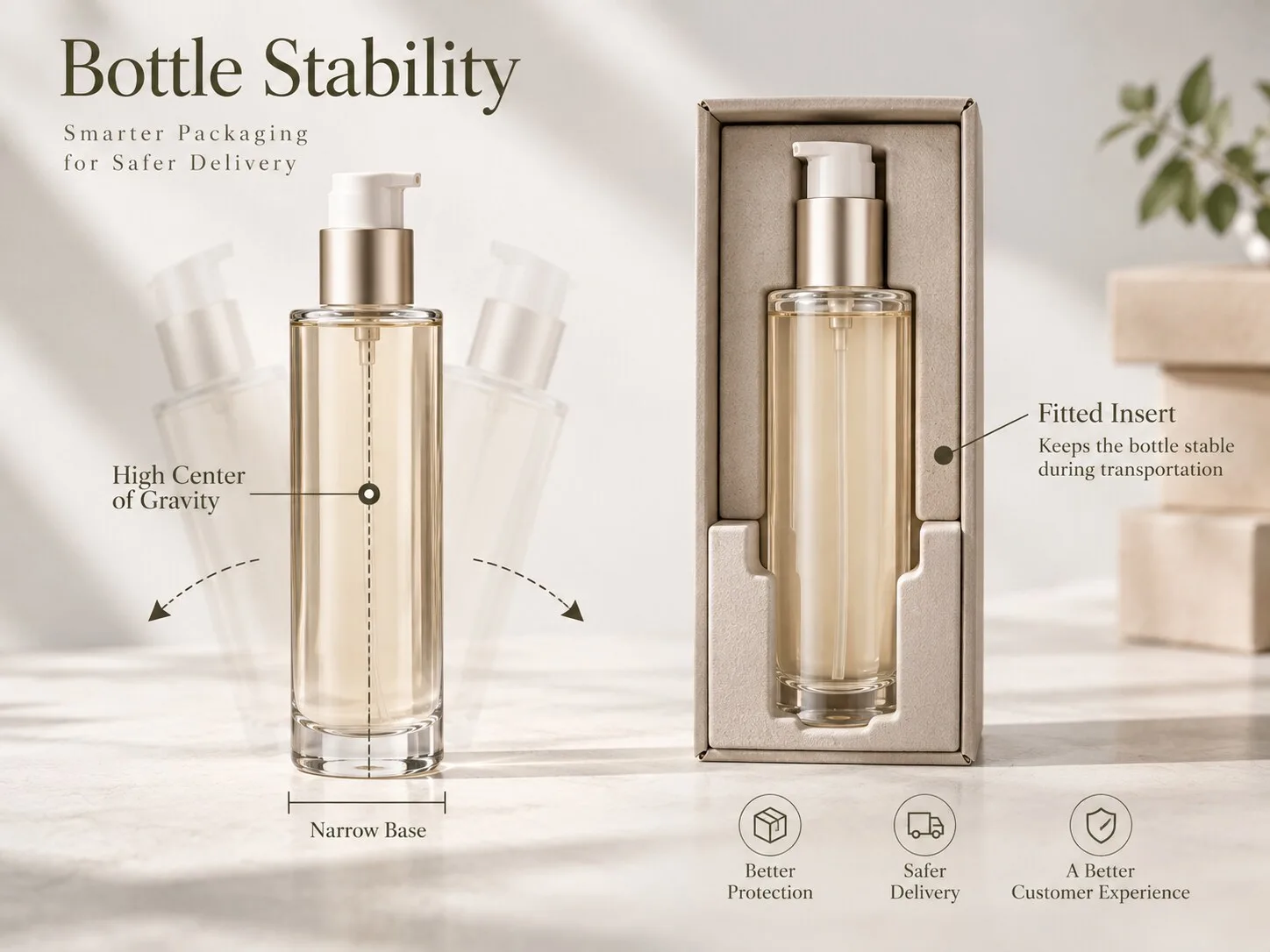
A bottle with a broad, well proportioned base generally gives packaging engineers more options for holding it securely. Tall and narrow bottles can create a higher center of gravity and may require tighter support inside the insert.
Highly sculpted or asymmetrical glass bottles can also work successfully in ecommerce. Their secondary packaging simply needs to follow the real bottle geometry.
Bottle weight is only one part of the evaluation.
The structural performance of a glass container is influenced by bottle geometry, glass distribution, base design, annealing quality, manufacturing consistency and the way the package is handled.
A heavy bottle therefore should not be treated as automatically stronger.
For DTC projects, review the bottle as an assembled package.
Install the final pump, dropper or cap. Place the bottle on a flat surface and assess stability. Look at the relationship between the base width, height and closure weight.
A heavy cap on a relatively narrow bottle, for example, changes the package balance.
The neck area matters too.
The bottle neck finish needs to match the selected closure correctly. Screw pumps and caps depend on appropriate thread engagement and sealing surfaces. Droppers, treatment pumps and fragrance sprayers each have their own compatibility requirements.
Closure fit becomes especially important during parcel distribution because repeated movement can reveal weaknesses that are less obvious during static display.
Irregular bottle shapes can be supported with fitted inserts.
The purpose of the insert is to control movement at appropriate contact points while leaving sensitive areas, such as actuators, decorative surfaces and shoulders, enough clearance.
This is why glass bottle shipping packaging should ideally be considered during bottle selection rather than after the bottle design has already been finalized.
A distinctive bottle can still be suitable for online retail. It simply benefits from a shipping structure developed around its geometry.
Pump Selection to Prevent Accidental Dispensing
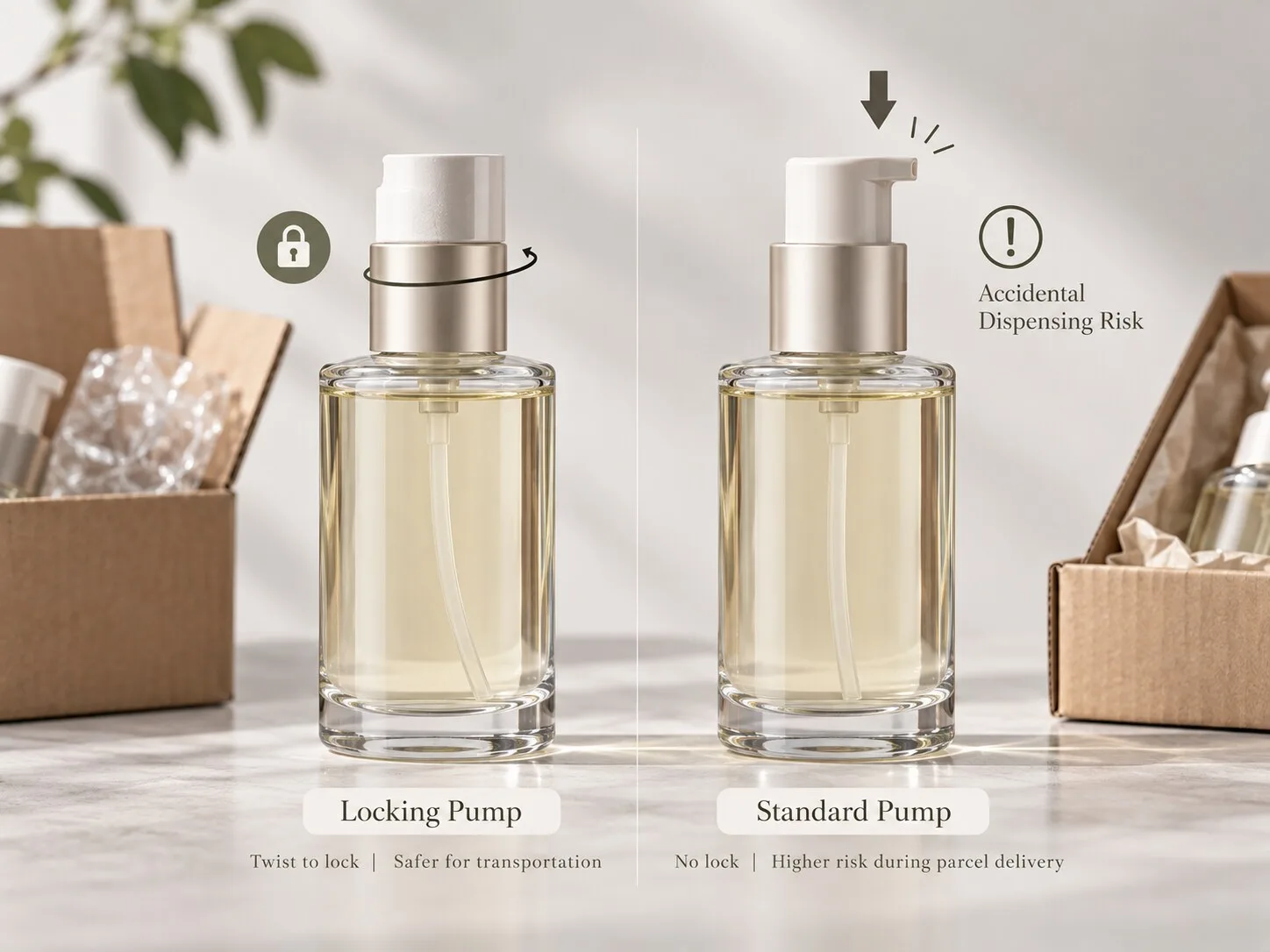
Dispensing systems deserve particular attention in ecommerce.
A pump that works perfectly on a bathroom shelf may experience a very different environment inside a parcel.
During distribution, the package can change orientation. Surrounding products or packaging materials may also apply pressure to the actuator.
Locking structures can help manage this risk.
Current dispensing suppliers increasingly describe products as ecommerce capable or suitable for omnichannel packaging, particularly when they incorporate twist to lock or down lock mechanisms.
Aptar, for example, offers dispensing systems with twist to lock and down locking structures that have undergone ISTA 6 Overbox testing for relevant ecommerce applications. Aptar also states that test results can vary according to container shape, container size and formula.That qualification matters.
A pump component passing a supplier test does not automatically validate every bottle and formula combination.
The finished package still needs to be evaluated.
For DTC skincare, buyers should check several areas.
The actuator should lock securely where a locking mechanism is part of the design.
An overcap, where used, needs enough retention to remain in place during normal distribution conditions.
The pump should have suitable clearance inside the retail carton and shipping structure.
Secondary packaging should also avoid continuous pressure on the actuator.
The dip tube needs to match the internal bottle geometry. Its cut length should follow the pump supplier's recommendation and the actual bottle dimensions.
Formula compatibility is equally important.
A pump tested initially with water may perform differently with a commercial serum, oil or lotion. Viscosity and formulation characteristics can influence priming, dispensing and output.
For skincare packaging for ecommerce, the useful sequence is:
select the bottle and compatible pump, test them with the intended formula, then evaluate the complete packed product in its distribution environment.
This approach is more reliable than treating pump security as an isolated closure question.
Secondary Packaging: Balance Protection, Product Presentation and Unboxing
Secondary packaging has a demanding job in DTC beauty.
It needs to support the product physically while helping create the presentation customers associate with the brand.
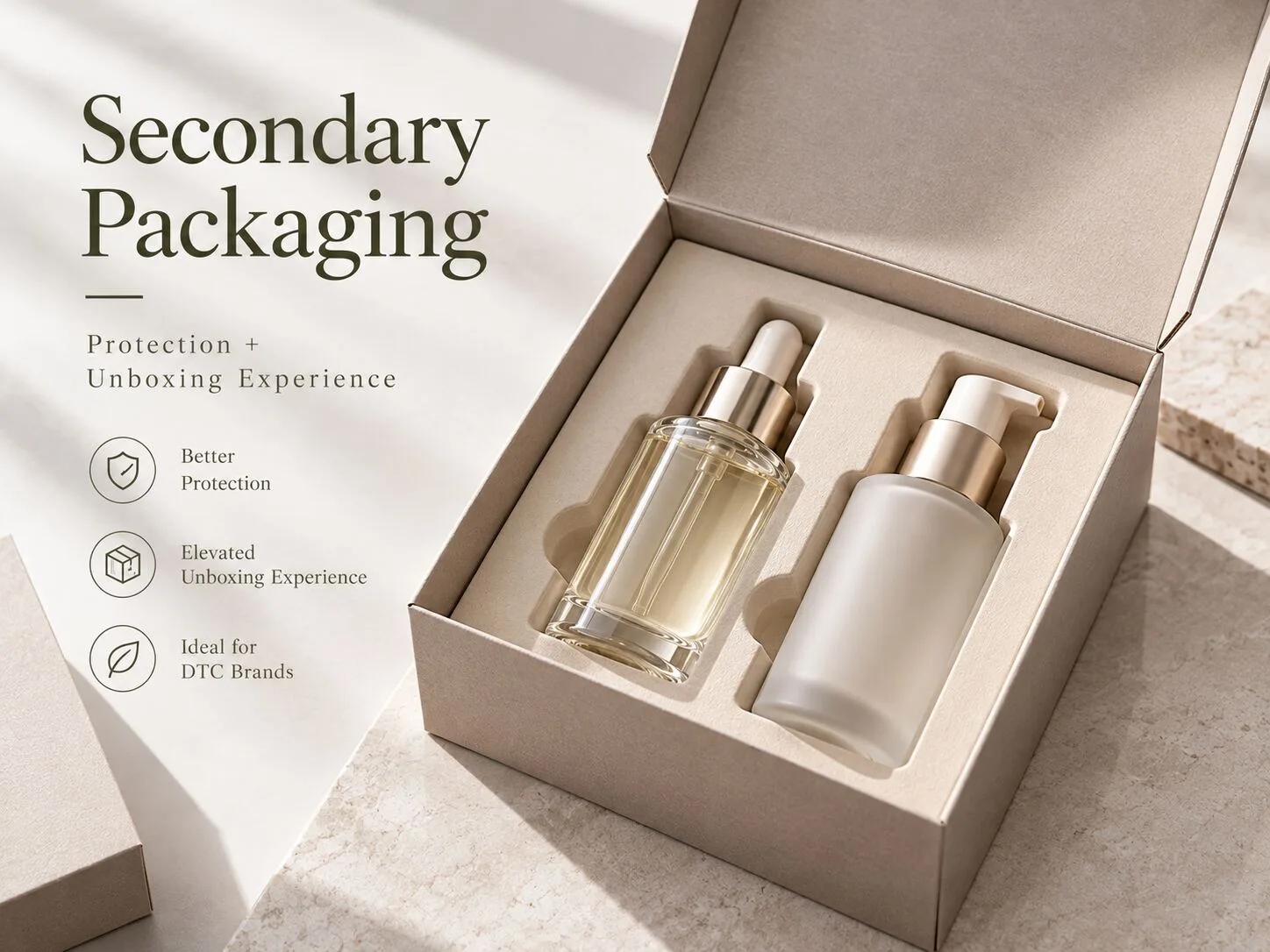
A lightweight serum bottle may work well inside a folding carton with an accurately cut paperboard insert.
A heavier glass bottle or premium skincare set may require stronger structural support.
Depending on the project, inserts can be made from paperboard, corrugated structures, molded pulp, EVA, EPE or other materials selected according to protection, visual direction, cost and end market requirements.
There is no universal insert material that suits every glass package.
Fit matters more.
A well designed insert controls bottle movement without placing unnecessary pressure on the pump, cap or glass shoulder.
It should also protect decorated surfaces.
Frosting, spray coating, silk screen printing and hot stamping create visual value, but the finished bottle may experience rubbing against paperboard, foam or other packaging materials during transport.
This deserves attention during sampling.
Place the final decorated bottle into the proposed insert and carton. Handle the pack in different orientations. Check whether the bottle rotates, whether the pump touches the carton and whether printed or coated surfaces contact rough edges.
The next question is presentation.
DTC brands often invest heavily in the beauty unboxing experience, and for good reason. Online customers usually encounter the physical package only after the purchasing decision has already been made.
The arrival experience therefore reinforces the brand promise.
Still, more material does not automatically mean a better unboxing experience.
Oversized boxes, thick decorative layers and unnecessary void space can increase parcel volume and shipping cost.
The more effective approach is to design protection and presentation together.
A fitted paper insert can feel clean and premium. A simple rigid structure can create strong product presentation when the product position is precise. Molded pulp can support a natural visual direction where that material suits the brand.
For procurement teams, the secondary package should be evaluated through three practical lenses:
protection performance, customer presentation and logistics efficiency.
The strongest solution is the one that balances all three.
Transportation Validation: Pre-Launch Risk Mitigation
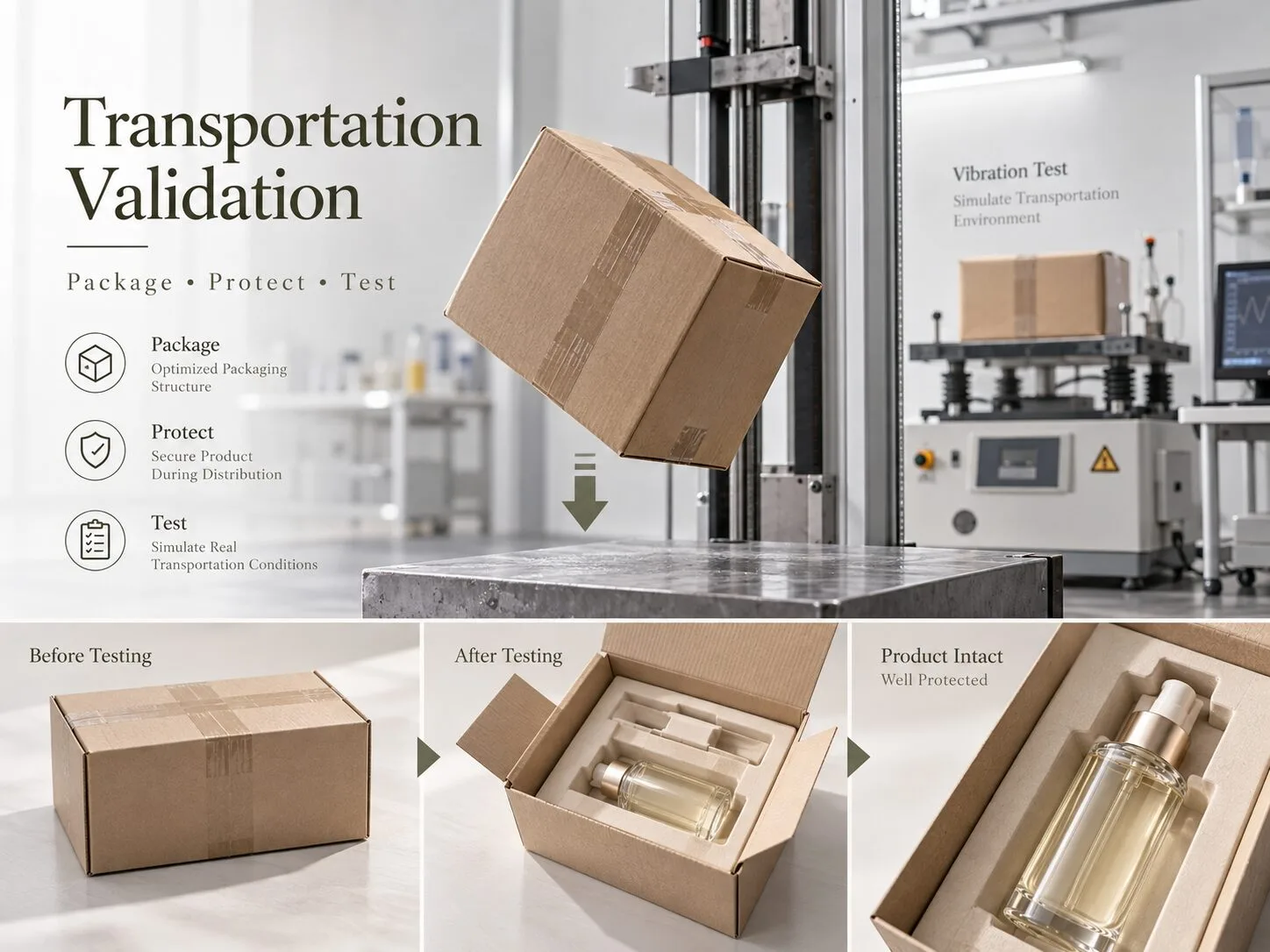
Transport validation is where packaging assumptions meet real test conditions.
For parcel delivery, ISTA provides established procedures designed to simulate relevant distribution hazards.
ISTA Procedure 3A applies to packaged products weighing 70 kg or less that move through parcel delivery systems. ISTA Project 3L is available for generalized ecommerce retailer fulfillment. Amazon specific packaging may fall under the relevant Project 6 Amazon procedure according to the fulfillment method and package configuration. This distinction is important for beauty brands.
There is no single test called “the ecommerce test” that fits every sales channel.
The procedure should reflect the actual distribution system.
A DTC brand shipping through its own third party logistics provider may have different requirements from a product prepared specifically for Amazon fulfillment.
Testing also needs to focus on the complete packaged product.
ISTA describes its procedures around the combination of the product and package rather than the container alone. For a skincare project, a representative test package may include:
the commercial or production representative glass bottle,
the final pump, cap or dropper,
the intended formula or suitable representative fill,
the retail carton,
the insert,
and the ecommerce shipping package.
After testing, inspect more than whether the glass survived.
Check for leakage around the closure.
Operate the pump again.
Review any locking mechanism.
Inspect the decorated surface for rubbing or scratches.
Check whether the insert shifted.
Look at the condition of the retail carton.
Then review the outer shipping box.
This gives product and packaging teams a much clearer picture of what actually happened during the distribution simulation.
Testing can also support iterative development.
If the glass remains intact but the pump actuator moves, the closure protection may need adjustment.
If the bottle is secure but decoration shows abrasion, the contact surfaces inside the insert may need refinement.
If the product performs well but the package is much larger than necessary, dimensional efficiency may be the next area to improve.
Transport validation should therefore be viewed as part of packaging development rather than as a final administrative step.
DTC E-Commerce Glass Packaging Practical Checklist
Before approving an online beauty package, review the project through five areas.
Bottle Stability
Evaluate the finished bottle with its closure attached.
Review the base, overall proportions, center of gravity and position inside the secondary packaging.
Closure Security
Confirm bottle neck compatibility, sealing, actuator protection and locking function where applicable.
For pumps and droppers, test dispensing again after transport simulation.
Functional Secondary Packaging
Use inserts and cartons that control movement while providing clearance around sensitive closure and decoration areas.
The structure should also support a clean unboxing sequence.
Parcel Delivery Testing
Select an appropriate validation approach according to the distribution route.
General parcel shipping, generalized ecommerce fulfillment and Amazon specific fulfillment can involve different ISTA procedures.
Logistics Efficiency
Review the final packed dimensions and weight.
Consider fulfillment handling, shipping carton size, void space and protective materials together with the desired brand presentation.
This checklist gives DTC brands a more practical framework for ecommerce cosmetic packaging.
It also improves communication between different suppliers.
The glass manufacturer can advise on the bottle.
The closure supplier can provide pump specifications.
The secondary packaging factory can design around the final assembled dimensions.
The filler and fulfillment partner can then review handling requirements.
That coordination matters because the consumer ultimately receives one complete package, not five separate components from different suppliers.
Conclusion & Call-to-Action
Online beauty packaging has to perform in two worlds.
It needs the visual refinement expected from skincare and fragrance, while also handling the physical demands of parcel distribution.
Glass can work very well in this environment when the package is developed as a complete system.
Bottle stability forms the starting point.
The pump, dropper or cap then needs to fit the container and remain secure through the intended distribution journey.
Secondary packaging controls movement and protects the finished surface.
Finally, appropriate parcel delivery testing provides useful evidence about how the whole package performs.
The recent growth of ecommerce ready packaging, twist to lock dispensing and omnichannel beauty packaging shows how seriously major packaging suppliers are treating online distribution requirements. Aptar's 2026 developments continue to connect locking systems and ecommerce capable dispensing with formal transport testing rather than relying only on conventional shelf performance.
For buyers, that is the useful takeaway.
Design for the way the product will actually travel.
NAISI Packaging supplies stock and custom cosmetic glass bottles for skincare, fragrance and private Turkish beauty projects. Available glass decoration includes frosting, sandblasting, spray coating, silk screen printing and hot stamping. Pumps, droppers and caps can also be coordinated according to the selected bottle and project requirements.
For DTC projects, sharing the bottle capacity, formula type, closure preference, order quantity and expected sales channel early makes the packaging discussion much more productive.
It allows the primary glass package to be developed with the real fulfillment journey in mind.
What creates the biggest challenge in your online beauty packaging projects: protecting the glass bottle, securing the pump, designing the insert or validating the finished parcel?