한국어
한국어 English
 日本語
日本語 Deutsch
 العربية
 Русский
 Türkçe
 Português
 Français

Crimp Pump vs Screw Pump: How to Choose the Right Perfume Spray Pump for Production
Choosing a beautiful fragrance bottle is only one part of preparing a perfume package for production.
Many development teams spend considerable time comparing perfume bottle sizes, glass clarity, bottle weight, caps and decoration. The spray system often receives attention later, even though it connects the glass bottle directly with filling, sealing and everyday dispensing performance.
For B2B buyers, the right perfume spray pump is primarily a technical matching decision.
The pump needs to correspond with the bottle neck finish, sealing system, required spray characteristics and filling equipment. Dip tube length, ferrule construction and component tolerances also need to be confirmed as part of the complete package.
A mismatch can appear during sampling, assembly or filling. Leakage, unstable assembly and inconsistent spraying are common signals that the bottle and dispensing system need to be evaluated together.
This guide compares crimp and screw fragrance pumps from a production perspective, helping perfume brands and packaging buyers select a system that can move smoothly from sample approval to commercial filling.
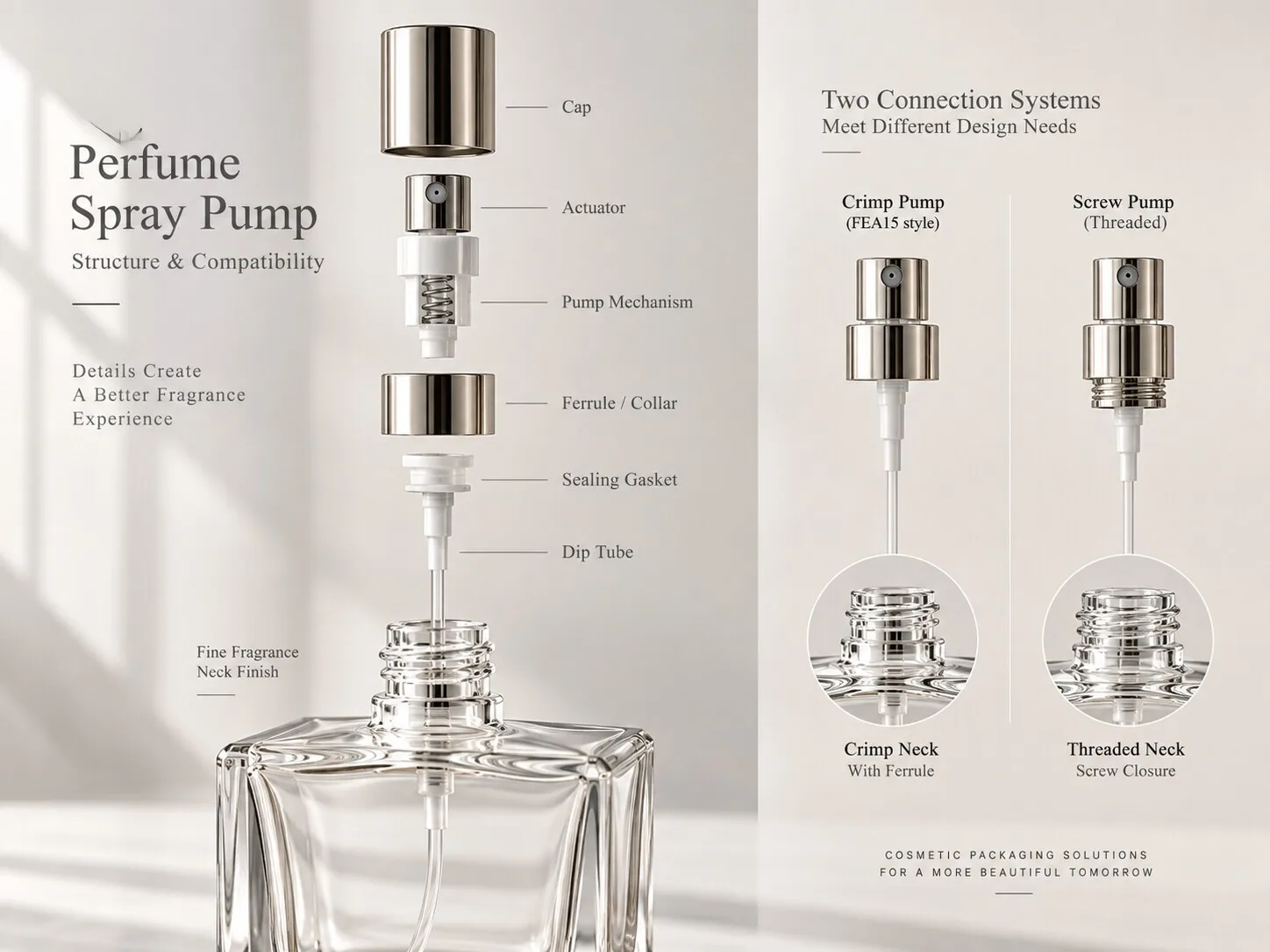
Crimp Pump vs Screw Pump: Two Main Types of Perfume Spray Pumps
Crimp and screw systems use different methods to secure the pump to the glass bottle. That structural difference affects neck finish selection, assembly equipment and the possibility of separating the pump from the bottle later.
Crimp Pump
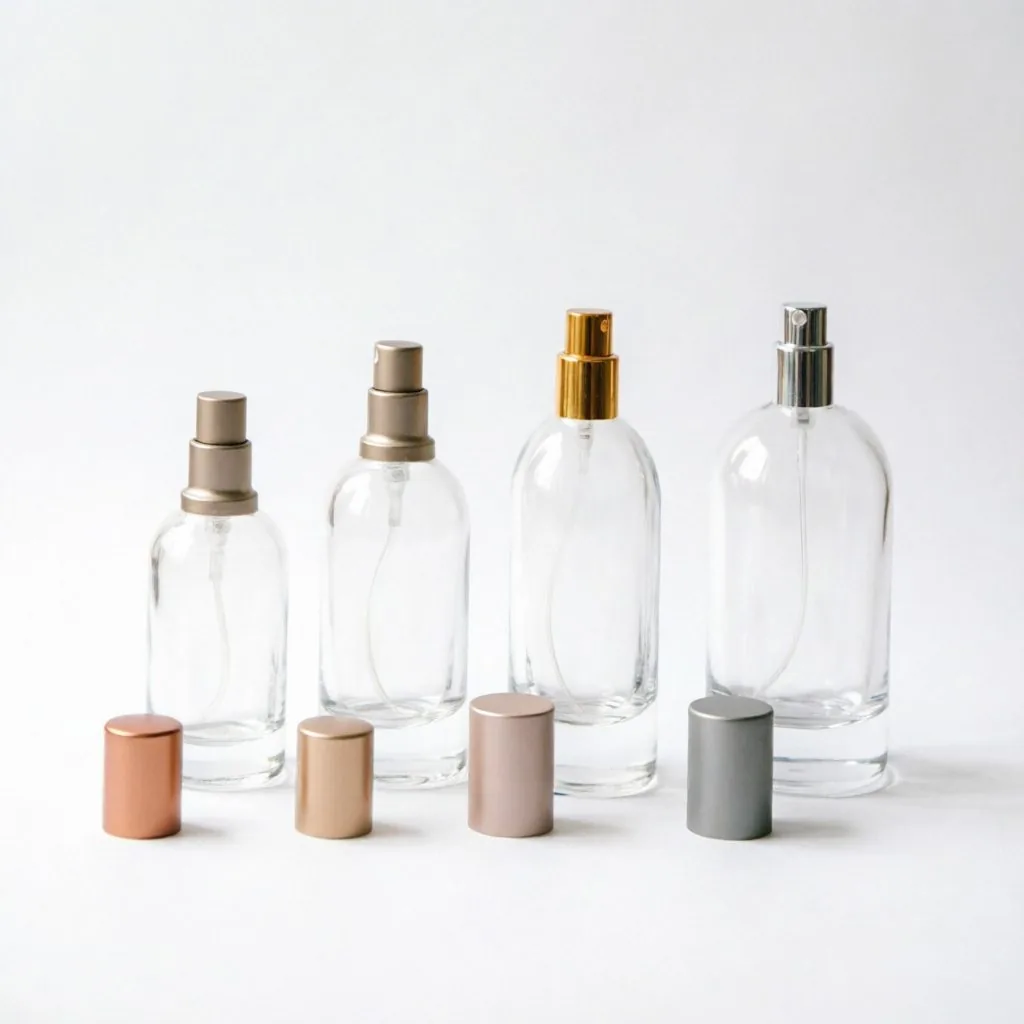
A crimp perfume pump uses a ferrule that is mechanically crimped onto the corresponding glass neck finish.
FEA type finishes are established within perfumery packaging. CETIE provides guidance for crimping pumps with aluminium ferrules onto FEA type glass finishes, including the use of a crimping tool.
FEA15 is particularly common in fine fragrance packaging. However, it is more accurate to treat FEA15 as a widely used option rather than a universal requirement. Other neck dimensions and dispensing systems exist, and CETIE documentation also covers additional finishes for perfume and cosmetic glass bottles.
For mass production, crimping requires suitable equipment and controlled setup.
The relationship between the crimping tool, ferrule, pump and glass neck needs to remain consistent. The objective is a secure assembly that performs according to the approved packaging specification.
This makes the crimp system particularly relevant to established perfume production lines already configured for this type of closure.
Screw Pump
A screw perfume pump uses a threaded closure structure matched to a corresponding threaded glass finish.
This construction provides a different development route for fragrance brands. The pump can be screwed onto the bottle rather than permanently crimped in the conventional way. Depending on the package design, this can support separability and refill oriented concepts.
Screw finishes have gained attention as fragrance companies explore reusable and more easily separable packaging systems. CETIE has developed SNI and CNI neck finish concepts intended to support greater interchangeability between screw and crimp configurations in perfume and cosmetic glass packaging.
Assembly requirements depend on the specific pump and production line. Small projects may use controlled manual or semi automated assembly, while larger operations can use automated torque controlled equipment.
The key point is specification control. Thread dimensions, sealing surface, torque requirements and pump construction should be matched as one system.
How to Choose Between Them
Start with the production project rather than the appearance of the pump.
Review the bottle neck finish first. Then consider the filling partner's equipment, intended production scale, refill strategy, pump availability and cap design.
A brand working with an established contract filler may find that the filler already has preferred neck finishes and crimping equipment. Another brand developing a refill oriented fragrance may have stronger reasons to explore an appropriate screw system.
The best choice is the one that fits both the package and the production environment.
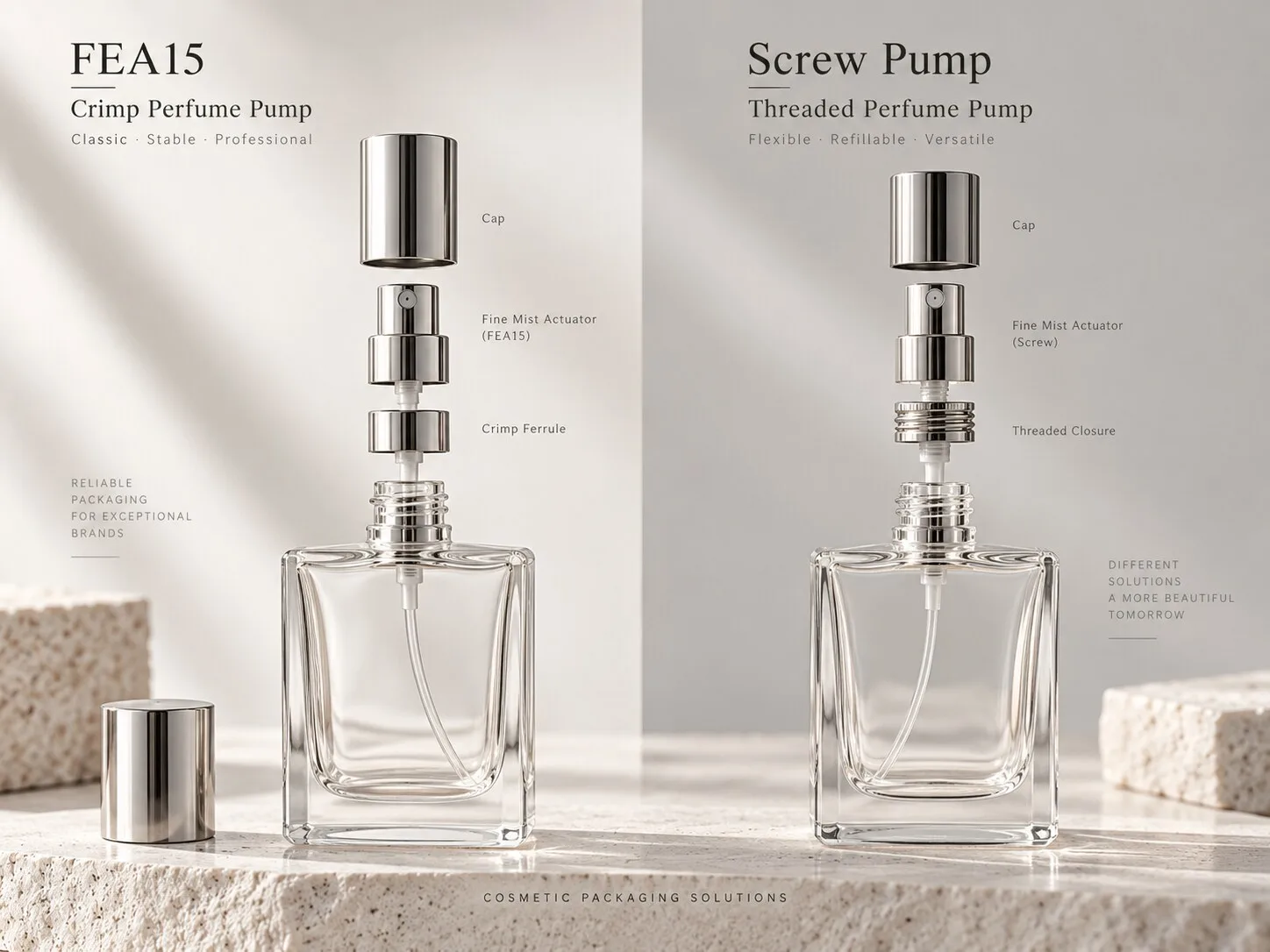
Key Component Parameters That Determine Pump Performance
A fragrance pump contains several functional parts, and each contributes to the performance of the assembled package.
Buyers should therefore approve more than the visible actuator and metal finish.
Collar
The collar or ferrule helps secure and visually finish the dispensing system around the bottle neck.
Its dimensions must correspond with the selected neck finish and pump structure.
Bottle capacity alone provides very little information here. Two 50ml perfume bottles, for example, can use different neck finishes or closure configurations.
This is why purchasing a pump simply because it is described as suitable for a "50ml perfume bottle" creates unnecessary uncertainty.
The correct reference is the technical bottle neck specification.
Glass production also works within dimensional tolerances. The bottle drawing, neck finish specification and actual production samples should therefore be considered during component testing.
For crimp systems, the crimping setup also matters. For screw systems, thread engagement and appropriate assembly torque become important considerations.
Gasket
The gasket is a small component with a significant sealing role.
It sits at the interface between the pump and bottle finish and contributes to the integrity of the assembled package. Its material, dimensions and compression characteristics should suit the selected pump, neck finish and fragrance formulation.
Fragrance formulas can contain alcohol, aromatic materials and other ingredients, so compatibility should be evaluated using the actual formula whenever possible.
A complete package test is more useful than assessing the gasket in isolation.
The bottle, pump, gasket, dip tube and fragrance should be tested together under storage and transport conditions relevant to the project.
Spray Output
Spray output, also called dosage, refers to the approximate volume dispensed during each full actuation. Fine fragrance pumps are available in different outputs depending on the pump design and desired spray characteristics. Outputs around 0.07 ml to 0.12 ml per actuation are commonly available for fine fragrance applications, while individual FEA15 pump models may offer lower or higher dosage options. The exact output should therefore be confirmed from the pump supplier's technical specification and tested with the intended fragrance before mass production.
This means 0.07ml to 0.12ml should be treated as a common product range rather than a universal perfume industry standard.
Output selection should consider the fragrance concept, desired spray characteristics and pump specification.
Bottle capacity can contribute to that decision, but it should not determine output by itself. A 30ml and 100ml bottle can potentially use the same pump output when the brand wants a consistent spraying experience across the range.
Atomization
Atomization is one of the most noticeable performance characteristics of a fragrance pump.
A well selected fine mist system should produce the spray pattern specified for the project consistently through repeated actuation.
Pump design and manufacturing precision play major roles, but atomization depends on more than one component.
The actuator, nozzle geometry, internal pump mechanism, formula characteristics, dip tube and assembly conditions can all influence performance.
This is why an uneven spray should trigger evaluation of the complete dispensing system rather than being attributed automatically to one mismatched accessory.
Brands developing premium fragrance packaging should test the intended pump with the actual formula before final approval.
Two Core Compatibility Conditions for B2B Buyers
For procurement teams, two questions should be answered early: does the pump fit the bottle, and can the complete package run through the intended production process?
Bottle Neck Compatibility
Perfume bottle capacity and perfume bottle neck finish are separate specifications.
A 30ml, 50ml or 100ml bottle does not automatically require a particular pump size.
A buyer may find two bottles with the same nominal capacity while one has a conventional FEA crimp finish and another uses a screw finish. Even bottles that look very similar from the outside can require different dispensing components.
CETIE maintains multiple finish specifications for perfume and cosmetic glass packaging, including traditional FEA systems as well as newer screw and interchangeable neck concepts.
For sourcing, ask the glass bottle supplier for the technical neck specification or drawing.
Then confirm the pump against that specification.
The dip tube also needs attention. Its length should correspond to the bottle's internal height and base geometry so the dispensing system performs as intended.
Finally, test the cap over the assembled pump. Internal cap dimensions need sufficient clearance around the actuator and collar while achieving the intended fit.
This sequence creates a more reliable package than selecting the bottle, pump and cap independently.
Filling Line Compatibility
A technically compatible bottle and pump still need to work with the production line.
For a conventional crimp system, the filling operation generally includes fragrance filling, pump placement and controlled crimping using equipment configured for the selected ferrule and neck finish. CETIE specifically provides guidance for proper crimping of aluminium ferrules on FEA glass finishes.
A screw system follows a different assembly process. Depending on production scale, the pump can be installed using suitable manual, semi automated or automated equipment. Commercial production should control assembly conditions such as torque according to the closure supplier's specification.
Before placing a packaging order, share the bottle and pump specifications with the filling partner.
For an existing filling line, confirm the supported bottle dimensions, neck finish, pump format and assembly equipment. Bottle stability and overall dimensions also matter for conveyor handling and filling line setup.
A pilot filling trial with production representative components can reveal practical issues before full production begins.

Pump Selection Reference Based on Perfume Bottle Sizes
Bottle size can help narrow down packaging options, although neck finish and production requirements remain the primary technical references.
10ml to 30ml Small Capacity Perfume Bottles
Compact fragrance bottles require a pump and cap system that stays visually proportional to the bottle while meeting sealing and dispensing requirements.
Depending on the bottle design, brands may use a compact crimp system, screw system or another compatible miniature fragrance closure.
For travel oriented packaging, sealing performance deserves particular attention because the finished product may spend more time in bags, gift sets or ecommerce parcels.
Dip tube length should be customized to the internal bottle geometry.
A small bottle also benefits from careful output selection. Rather than assuming that every small format requires the lowest possible dose, evaluate how the fragrance should spray and how many actuations the consumer is expected to use.
50ml Medium Capacity Perfume Bottles
The 50ml format gives brands broad packaging flexibility.
FEA15 crimp systems are commonly available for fine fragrance applications, and CETIE identifies the 15mm FEA finish as an important format within the crimp fragrance market.
This availability can make FEA15 convenient for projects using established perfume packaging supply chains.
Still, a 50ml bottle does not automatically mean FEA15.
The bottle drawing and neck specification remain the deciding references. Brands using refill oriented designs may also evaluate compatible screw systems.
For production, test the complete 50ml package with the filling partner, especially when introducing a new bottle shape, heavy glass design or customized cap.
100ml and Larger Perfume Bottles
Larger fragrance bottles can also use FEA crimp or appropriate screw systems, depending on the glass neck design.
A 100ml bottle does not inherently require a stronger pump simply because it contains more fragrance. The closure system should instead be selected according to neck geometry, bottle design, sealing requirements and intended dispensing performance.
Output deserves thoughtful evaluation as well.
Higher output is not automatically better for a larger bottle. Fine fragrance typically benefits from a controlled mist selected for the intended application, while body sprays and other products may use different dispensing specifications.
For brands offering 30ml, 50ml and 100ml versions of the same fragrance, maintaining a consistent spray experience across the collection can be more valuable than changing pump output simply because capacity increases.
Common Procurement Mistakes Before Mass Production
The first common issue is choosing a fragrance pump primarily by appearance.
Metal color, actuator shape and collar profile certainly matter for premium packaging, but the neck finish and internal pump specification should be confirmed first. Once technical compatibility is established, visual customization can follow.
The second issue is combining components from different pump systems without complete testing.
A collar, gasket, actuator or dip tube may look similar across several references while carrying different dimensions or material specifications. Using the pump supplier's validated component configuration gives buyers a clearer technical baseline.
The third issue appears when a package performs well during basic hand sampling but reaches mass production without a representative filling line trial.
Manual sample assembly and commercial filling are different environments.
Production introduces equipment settings, repeated handling, line speed, crimping or torque control and larger component batches. A pilot run using production representative bottles, pumps and fragrance allows the filling partner and packaging supplier to evaluate the package under conditions closer to commercial manufacturing.
A good approval process therefore moves through several levels: component matching, assembled package testing, formula compatibility and production line validation.
Conclusion
A perfume pump is a functional part of the fragrance packaging system, and its selection should begin much earlier than final assembly.
The most reliable approach is to start with the perfume bottle neck finish, then match the appropriate crimp or screw pump, gasket, ferrule or collar, dip tube and cap. Spray output and atomization should be evaluated with the intended fragrance, while the complete package should also be checked against the filling partner's production equipment.
Perfume bottle sizes remain useful when planning the overall packaging range, but capacity alone cannot define the correct dispensing system.
A 30ml, 50ml and 100ml fragrance collection may share a pump specification, or each bottle may require a different configuration. Technical drawings, actual samples and production requirements provide the answer.
For brands preparing commercial fragrance production, NAISI Packaging can coordinate glass perfume bottles with suitable spray pumps, caps and decoration according to the selected packaging project. Bottle neck specifications and component matching can be reviewed during sampling, followed by compatibility and filling line evaluation with the relevant production partners.
This integrated approach helps move a fragrance package from design approval to mass production with greater clarity and fewer avoidable adjustments.
Explore glass fragrance packaging and custom surface solutions with NAISI Packaging.