日本語
日本語 English
 Deutsch
 한국어
한국어 العربية
 Русский
 Türkçe
 Português
 Français
Why Cosmetic Glass Bottles Sometimes Break During Filling
A cosmetic glass bottle can look perfect during incoming inspection and still break once it reaches the filling line.
For beauty brands and packaging buyers, this situation is frustrating because the bottle often appears to have no obvious defect. Yet glass performance depends on much more than surface appearance. Bottle dimensions, glass distribution, residual stress, filling line settings, component assembly, handling conditions, and temperature all contribute to how a container performs during production.
This is especially important for automated cosmetic bottle filling, where bottles move through filling, capping, conveying, gripping, labeling, and packing equipment at production speed. A small dimensional or process variation that causes little concern during manual sampling can become more significant when thousands of bottles pass through the same equipment.
The practical approach is to evaluate the glass bottle as part of the complete filling system.
Before mass production, cosmetic brands should understand five areas in particular: bottle mouth tolerance, wall thickness and glass distribution, annealing, mechanical and thermal pressure, and production consistency.
Bottle Mouth Tolerance
The neck of a cosmetic glass bottle is one of its most functionally important areas.
It connects the glass container with a pump, dropper, cap, sprayer, collar, or another closure system. It may also interact directly with filling and capping equipment. For this reason, dimensional consistency around the neck finish deserves close attention during packaging development.
A bottle can have an attractive shape and excellent surface quality while still creating assembly challenges if the neck dimensions fall outside the agreed specification.
For screw neck bottles, the relevant dimensions influence how the closure engages with the glass finish. For other closure systems, different dimensional characteristics become important. The exact requirements depend on the bottle and component design.
This is why buyers should work from technical specifications rather than visual appearance alone.
The glass bottle drawing, closure drawing, and component specification should be reviewed together. When an existing filling line will be used, the filler should also confirm that the selected package is suitable for its equipment.
Dimensional consistency can affect more than closure fit.
A bottle entering automated capping equipment needs to remain correctly positioned while the component is applied. Variation around critical dimensions may influence alignment, assembly force, or equipment adjustment.
Preproduction quality control should therefore include measurement of critical bottle dimensions according to the agreed specification and sampling plan.
For buyers, a useful question is:
Has the bottle neck been evaluated together with the actual pump, dropper, cap, or sprayer that will be used in production?
That question often reveals more than simply asking whether a bottle is a standard size.
The complete packaging set matters.
Wall Thickness
A common assumption in cosmetic packaging is that heavier glass automatically means stronger glass.
In practice, glass distribution is more important than weight alone.
A premium serum bottle may have a substantial base to create visual presence and a satisfying hand feel. A fragrance bottle may also use significant glass mass as part of its design language. Neither feature by itself guarantees how the bottle will behave on a filling line.
The way the glass is distributed throughout the container deserves attention.
Shoulders, corners, the heel, base transitions, and areas where the bottle geometry changes can require careful forming control. In shaped bottles, the relationship between design geometry and glass distribution becomes particularly relevant.
If glass distribution varies significantly, some areas can carry stress differently from others when the bottle is handled or subjected to mechanical force.
This is one reason two cosmetic bottles with similar overall weight can perform differently.
For procurement teams, evaluating glass quality should therefore go beyond a simple gram weight comparison.
Review the bottle structure.
Check dimensional consistency.
Look at glass distribution and forming quality.
Consider whether the design includes sharp transitions or other features that require closer manufacturing control.
The same principle applies when developing custom cosmetic glass bottles. Designers naturally focus on silhouette, proportions, base thickness, and shelf appearance. Manufacturing feasibility should enter the discussion at the same stage.
A bottle that combines strong aesthetics with a well considered glass structure is easier to manage through production, decoration, filling, transportation, and consumer use.
This is particularly valuable for DTC skincare and fragrance brands, where packaging must perform through both production and parcel distribution.
Annealing
Annealing is one of the most important manufacturing concepts to understand when discussing glass bottle strength.
During glass container production, the formed bottle leaves the mould at a high temperature. Glass cools from the exterior and interior at different rates, and uncontrolled cooling can leave residual stresses within the container.
Annealing manages this process through controlled heating and cooling.
The objective is to reduce residual stress generated during forming and cooling so that the finished container has a more stable stress condition for subsequent handling.
This distinction matters because annealing is sometimes incorrectly described in packaging discussions as a process that improves liquid sealing or prevents formula leakage.
Its primary relevance here is residual stress in the glass structure.
Sealing performance depends mainly on the complete closure system, including the bottle neck, closure or pump, sealing surfaces, gaskets or other relevant components, and the way those components are assembled.
Annealing addresses a different issue.
A bottle carrying excessive residual stress can become more vulnerable when additional mechanical or thermal stress is introduced later. Filling, capping, conveying, transportation, or temperature changes may then expose a weakness that was not immediately visible during a basic visual inspection.
For demanding projects, brands and fillers should discuss annealing control with their glass bottle manufacturer.
Quality evaluation may include appropriate methods for examining residual stress in glass containers, depending on the bottle type, customer specification, and factory quality system.
This is particularly important when a brand is troubleshooting unexplained breakage.
A bottle breaking on the filling line does not automatically mean annealing is the cause. The failure should be investigated systematically. Bottle dimensions, impact damage, glass distribution, line pressure, temperature, component assembly, and handling history may all contribute.
Treating annealing as one part of the investigation leads to a much more accurate conclusion.
Pressure
The word "pressure" can be misleading in cosmetic bottle filling because several different forces may act on the bottle during production.
The filling operation itself is only one stage.
Before a finished cosmetic product reaches its carton, the glass container may pass through unscrambling, conveying, positioning, filling, capping, labeling, inspection, and packing.
At different points, guides, clamps, star wheels, grippers, capping heads, or other equipment may contact the bottle.
A well designed production line controls these interactions carefully.
Problems can develop when a bottle is gripped too firmly, becomes misaligned, receives localized impact, or encounters an equipment setting developed for a different container geometry.
Capping is another area worth reviewing.
The appropriate assembly force depends on the closure system. A screw cap, cosmetic pump, dropper, or fragrance component can have different installation requirements. The component supplier and filler should provide the relevant specifications for the selected package.
This is why transferring a new glass bottle onto an existing line deserves a trial rather than assuming that previous machine settings will suit the new container.
Thermal conditions also matter.
Glass responds to temperature differences. When the product filling temperature and bottle temperature differ substantially, the packaging team should assess whether the intended process is suitable for the selected container.
This should be based on the actual formula, process temperature, bottle design, and filling conditions rather than a universal temperature figure.
For most beauty brands, the practical solution is straightforward:
Run a filling trial using production representative bottles.
Use the intended formula or an appropriate validated test medium.
Install the actual closure components.
Operate the relevant production equipment under representative conditions.
Observe the complete journey of the bottle rather than focusing only on the filling nozzle.
A successful cosmetic bottle filling trial gives both the brand and filler valuable information before commercial quantities enter production.
Production
Even a well designed glass bottle needs consistent manufacturing and careful handling to perform reliably.
This is where packaging quality becomes a supply chain issue rather than a single factory checkpoint.
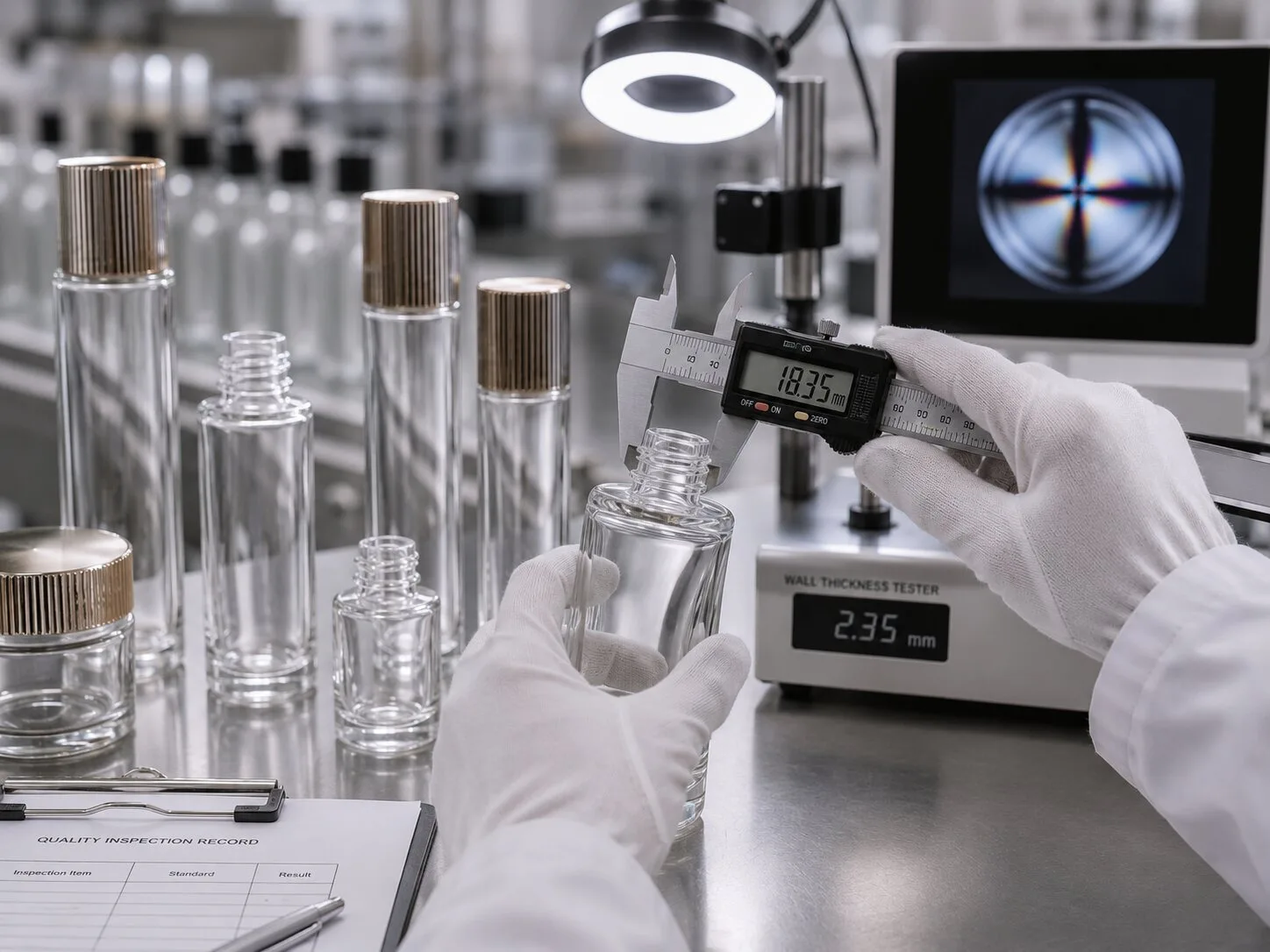
A production batch should be evaluated against the specifications agreed between the buyer and manufacturer. Depending on the project, inspection can cover critical dimensions, visible glass defects, decoration quality, component fit, packing condition, and other agreed characteristics.
Visual inspection is particularly useful for identifying manufacturing or handling conditions that could affect appearance or performance.
Dimensional inspection provides another layer of control.
Critical measurements should correspond to the bottle drawing and the functional requirements of the closure system. For a cosmetic packaging buyer, this creates a measurable reference when communicating with the bottle manufacturer, component supplier, and filler.
Packing and transportation deserve equal attention.
Glass bottles can leave the factory in good condition and experience impact during internal handling, pallet movement, export transportation, warehousing, or transfer to the filling plant. Packaging designed to keep bottles separated and stable during transportation helps preserve the condition established at the glass factory.
This becomes especially relevant for decorated bottles.
Frosted, spray coated, silk screen printed, or hot stamped glass containers require packing that protects both the bottle and its finished surface.
Once the bottles reach the filling facility, line handling becomes the next variable.
A pilot run is one of the most useful steps before full scale production.
Instead of testing only a few bottles manually, a representative quantity can be introduced to the intended line so that the team can observe feeding, conveying, filling, component assembly, labeling, and downstream handling.
Any adjustment can then be made while the project still has flexibility.
For private label beauty brands and new DTC businesses, this step may feel like extra preparation. In reality, it creates useful information before the commercial launch.
It also helps separate bottle related issues from filling line issues.
If breakage repeatedly occurs at the same position on the line, the location and fracture pattern can provide clues for investigation. If the issue appears across different stages, the team may need to review the bottle batch, transportation history, handling, or other variables.
The strongest troubleshooting process involves all relevant parties.
The glass manufacturer understands the container and forming process.
The component supplier understands the pump, dropper, cap, or sprayer.
The filler understands the equipment and operating conditions.
The brand understands the formula, commercial requirements, and consumer experience.
When these teams share technical information early, packaging development becomes far more predictable.
A Better Way to Approach Cosmetic Bottle Filling
For overseas beauty brands, packaging selection often begins with samples.
That makes sense. Buyers need to see the glass clarity, feel the bottle weight, inspect the finish, and evaluate how the package supports the brand identity.
The next stage should become more technical.
Once a bottle is shortlisted, confirm the drawing and neck finish. Match the closure. Review critical dimensions. Discuss the intended filling process. Evaluate representative samples with the formula and production equipment.
For custom glass bottles, bring the filling partner into the project before the design is fully locked.
For stock cosmetic glass bottles, confirm that the selected bottle and components are suitable for the intended application rather than relying solely on their previous use in another product.
This approach is particularly useful for serum bottles, lotion bottles, foundation bottles, fragrance bottles, and other glass packages using dispensing components.
A packaging system that looks beautiful in photography still needs to move smoothly through commercial production.
That combination is what makes good cosmetic packaging valuable.
Final Thoughts
Glass bottle breakage during filling rarely comes down to one visible characteristic.
Bottle mouth tolerance influences how the container interfaces with closures and equipment. Glass distribution affects how the structure responds to force. Annealing controls residual stress created during manufacturing. Filling line settings and handling introduce mechanical and sometimes thermal demands. Production consistency ties all of these factors together.
For cosmetic packaging buyers, the most effective approach is to evaluate the bottle as part of a complete system.
The glass container, closure, formula, filling line, packing method, and production environment all need to work together.
At NAISI Packaging, we supply stock and custom cosmetic glass bottles for skincare, fragrance, and beauty brands, with surface finishing options including frosting, sandblasting, silk screen printing, hot stamping, and spray coating. For projects moving into commercial filling, technical specifications and component matching can be discussed early in the sourcing process.
Planning a new cosmetic filling project? Share your bottle specifications and filling requirements with NAISI Packaging to discuss a suitable glass packaging solution.