Français
 English
 日本語
日本語 Deutsch
 한국어
한국어 العربية
 Русский
 Türkçe
 Português
The Ultimate Guide to Serum Bottle Packaging for Skincare Brands | Materials, Sizes & Decoration
The Ultimate Guide to Serum Bottle Packaging for Skincare Brands
Introduction
Serums have become one of the fastest growing categories in the global skincare market. From hydrating formulas and brightening concentrates to advanced anti aging treatments, they often represent the highest value product in a beauty brand's portfolio.
Consumers expect visible results, refined textures, and a premium user experience. While brands invest heavily in ingredient research and formulation, many overlook one critical factor that directly affects both product performance and customer perception.
The packaging.
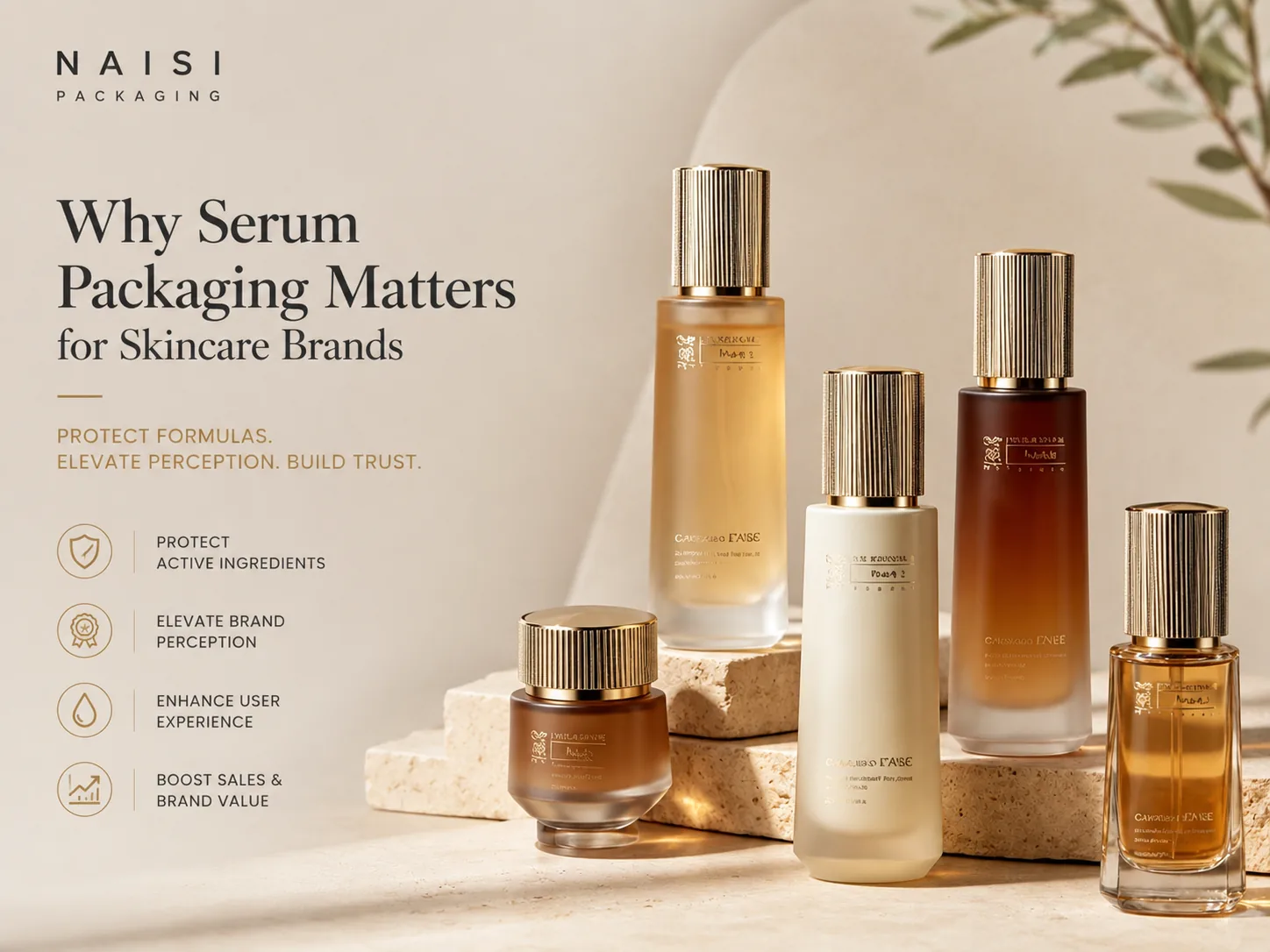
A serum bottle is far more than a container. It protects delicate formulas, supports premium positioning, enhances shelf appeal, and influences how customers perceive product quality before reading a single ingredient.
Selecting the right serum bottle packaging requires much more than choosing an attractive shape. Glass material, bottle capacity, neck finish, dispensing system, decoration techniques, and production consistency all contribute to the success of a finished product.
For emerging private French brands, making the right packaging decisions early can also reduce development costs, simplify production, and shorten the path from concept to launch.
This guide explores how to choose cosmetic glass packaging for serum products, helping skincare brands create packaging that protects valuable formulations while strengthening brand value in an increasingly competitive market.
Why Serum Packaging Matters for Skincare Brands
Unlike facial cleansers or body lotions, serums are typically formulated with concentrated active ingredients that require greater protection throughout storage and daily use.
Ingredients such as Vitamin C derivatives, retinoids, peptides, botanical extracts, and antioxidants are often more sensitive to light, oxygen, and repeated exposure during application. Although formulation stability depends on the complete product system and manufacturer validation, packaging plays an important supporting role in preserving product quality during normal storage and consumer use.
For premium skincare, packaging becomes part of the overall product experience.
Before customers test the formula, they evaluate what they can immediately see and feel.
They notice the clarity of the glass.
They feel the weight in their hand.
They observe how smoothly the pump dispenses each dose.
They pay attention to details such as decoration quality, printing precision, and component fit.
These visual and tactile signals quickly shape expectations about product quality.
This explains why many luxury skincare brands invest significant resources in premium cosmetic glass packaging. Packaging communicates craftsmanship long before consumers experience the formula itself.
The right serum bottle also supports operational performance.
Well-designed packaging can improve filling efficiency, maintain reliable compatibility between bottles and dispensing components, reduce leakage risks during transportation, and create a more consistent experience across different production batches.
For brands selling through retail stores, department stores, beauty boutiques, Amazon, or direct-to-consumer websites, attractive packaging also improves photography, video content, influencer marketing, and social media engagement.
In today's digital marketplace, packaging frequently becomes the first brand impression.
Best Glass Material for Serum Bottles
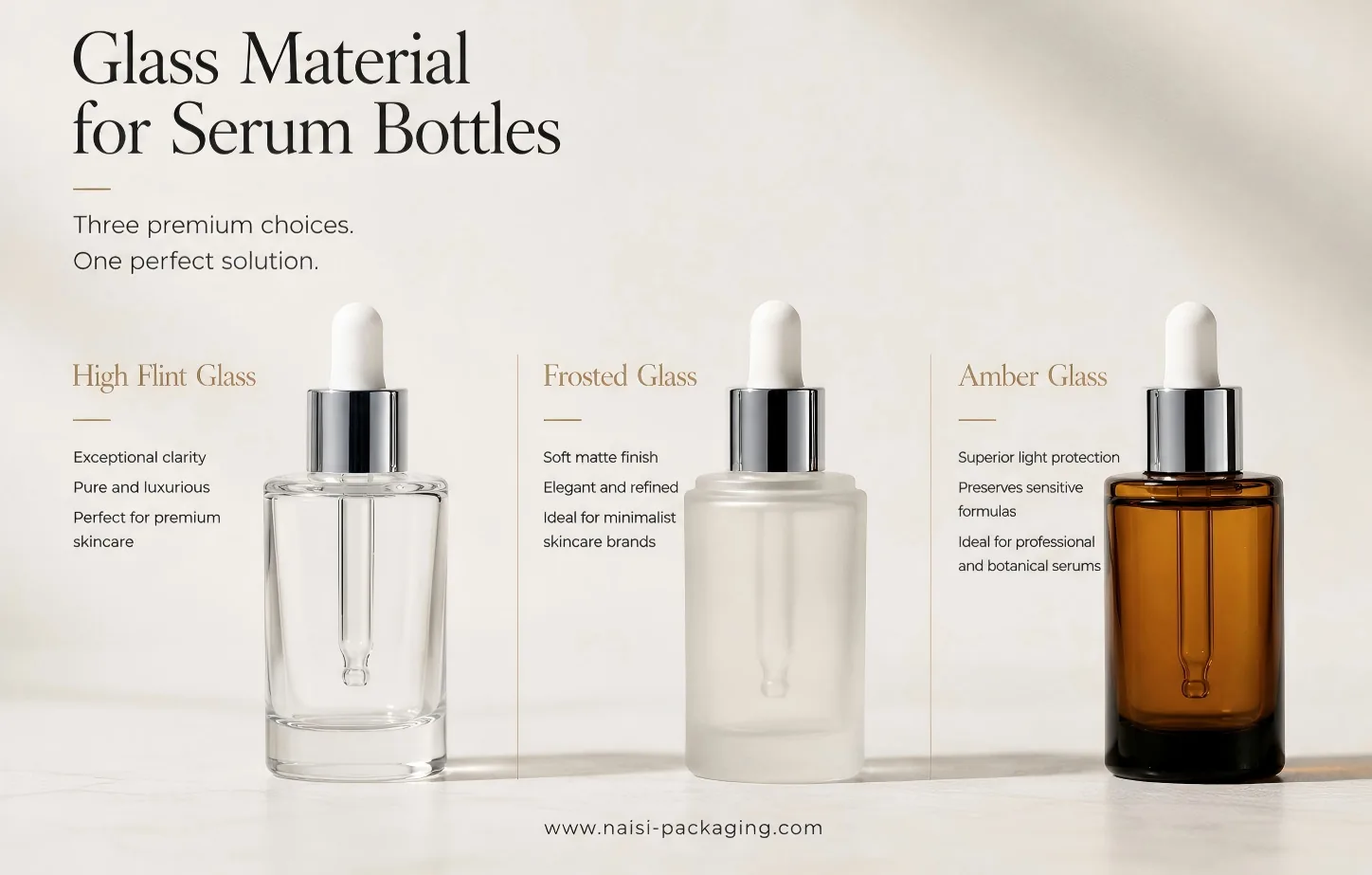
Glass remains one of the preferred packaging materials for premium skincare because of its elegant appearance, excellent barrier properties, and compatibility with a wide range of cosmetic formulations.
Choosing the appropriate glass material helps brands balance aesthetics, product positioning, and long-term performance.
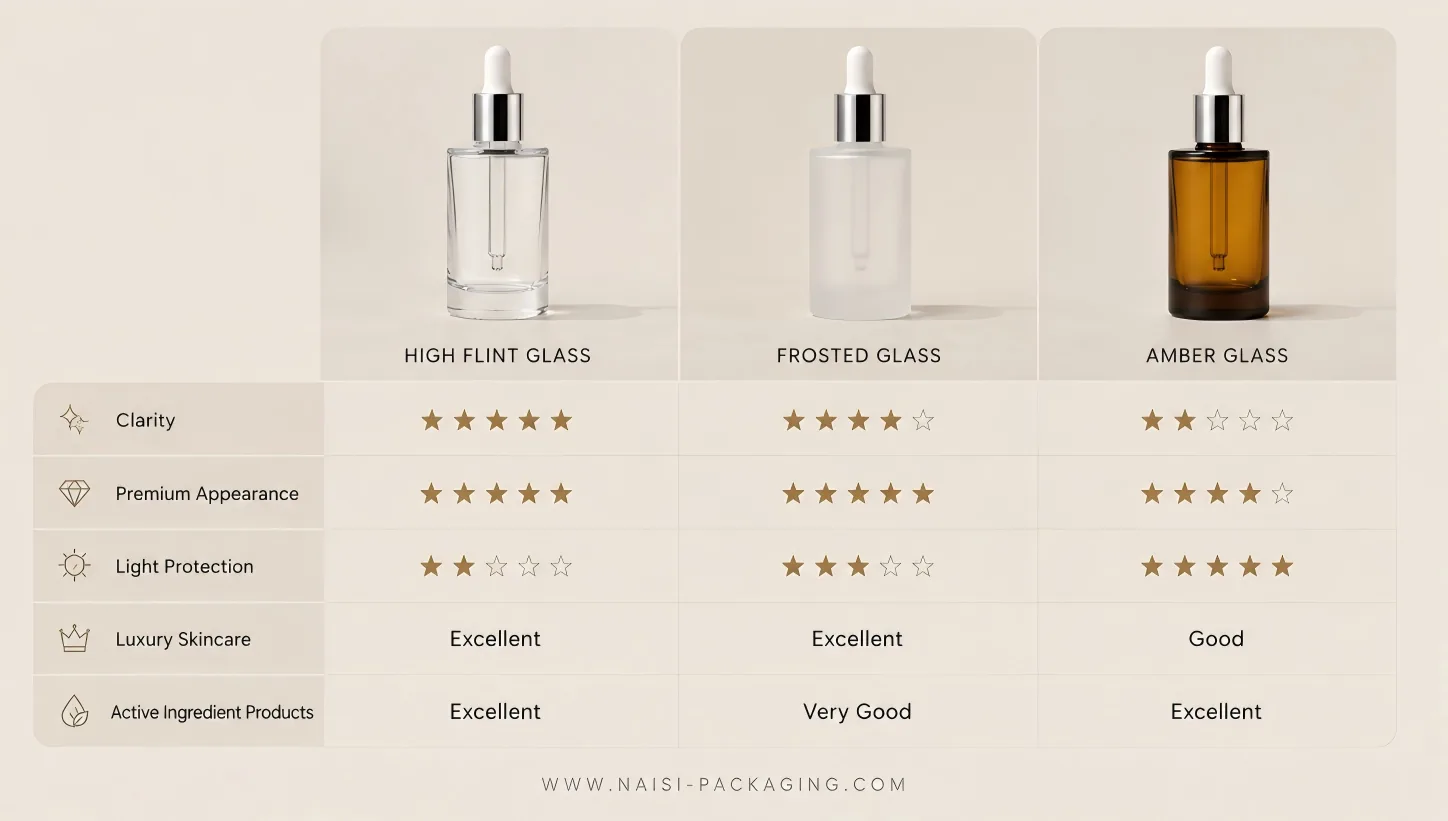
High Flint Glass
High Flint glass has become the preferred choice for premium serum packaging.
Manufactured from highly refined raw materials, it offers exceptional transparency and a clean, crystal-like appearance that showcases the natural beauty of modern skincare formulations.
For brightening serums, peptide concentrates, hydrating essences, and luxury anti aging products, High Flint glass reinforces a premium brand image while delivering excellent visual clarity.
Its consistent appearance also creates superior results during decoration processes such as frosting, screen printing, hot stamping, and metallized finishes.
Brands targeting prestige retail channels often select High Flint cosmetic glass bottles because they elevate perceived product value without requiring complex bottle designs.
Frosted Glass
Frosted glass has become increasingly popular among minimalist skincare brands.
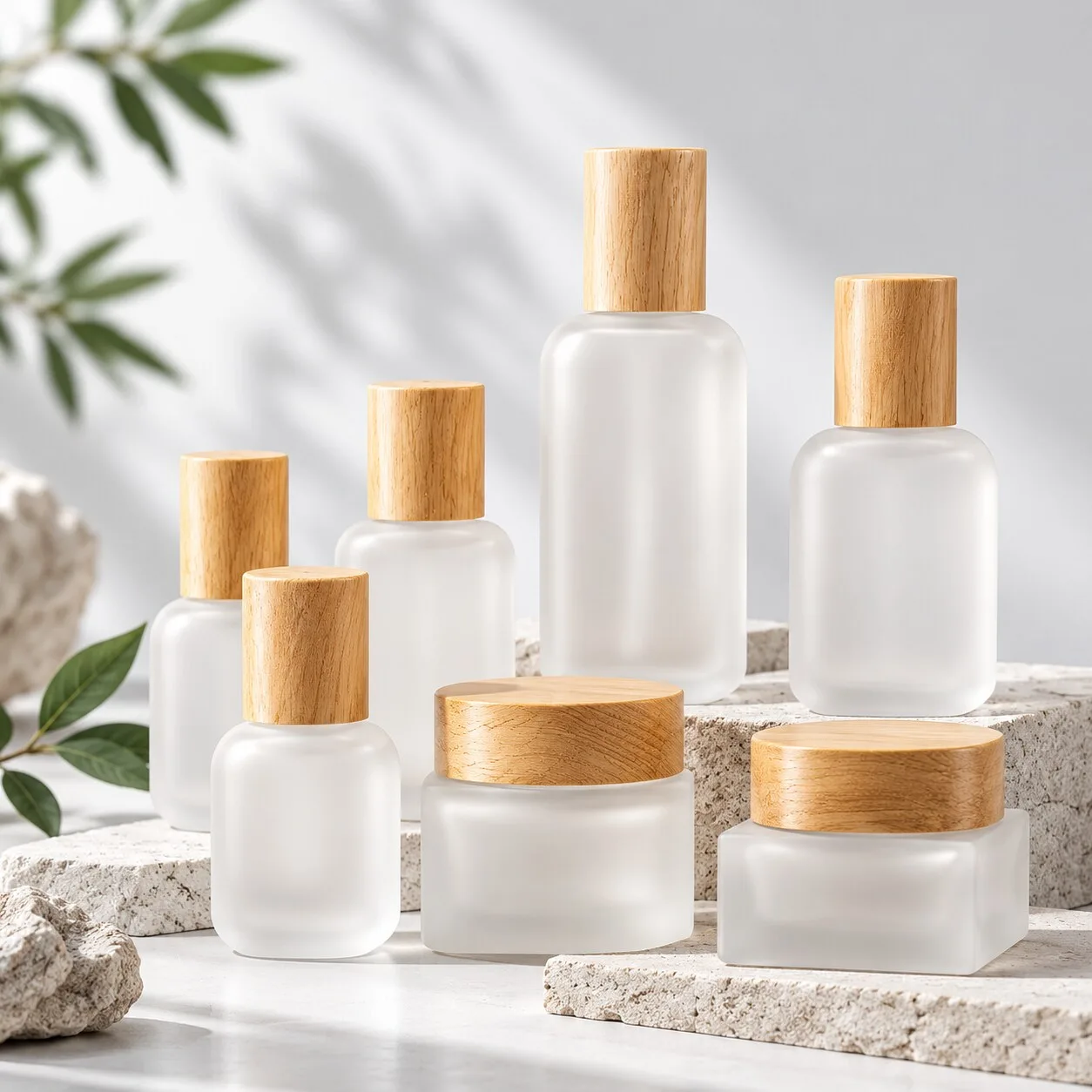
The soft matte surface creates a refined appearance while gently diffusing light, giving products a clean and sophisticated aesthetic.
Many beauty brands associate frosted serum bottles with premium skincare collections because the finish communicates simplicity, quality, and modern elegance.
Frosted finishes also reduce visible fingerprints during daily handling, helping products maintain a cleaner appearance throughout consumer use.
When combined with High Flint glass, frosting creates one of the most recognizable luxury packaging styles found in today's skincare market.
Amber Glass
Amber glass bottles are widely used for formulations that benefit from enhanced light protection during storage.
Many brands select amber cosmetic glass bottles for products containing light sensitive ingredients or botanical extracts, particularly when the desired brand image emphasizes professional skincare, apothecary aesthetics, or clean beauty positioning.
The darker appearance also creates strong visual differentiation from conventional transparent packaging while reinforcing a premium, ingredient focused identity.
It is important to note that packaging selection should always be evaluated together with formulation characteristics and stability testing performed by the product manufacturer. Packaging supports formulation protection, while compatibility testing remains an essential step before commercial production.
The ideal glass material depends on your product positioning rather than a single universal standard.
A luxury brightening serum may benefit from crystal clear High Flint glass.
A minimalist premium skincare collection may achieve stronger brand recognition through frosted finishes.
A professional treatment serum or botanical formula may align naturally with amber glass packaging.
The best packaging solution combines visual appeal, formulation compatibility, production efficiency, and long-term brand strategy rather than focusing on appearance alone.
Standard Serum Bottle Capacity Guide
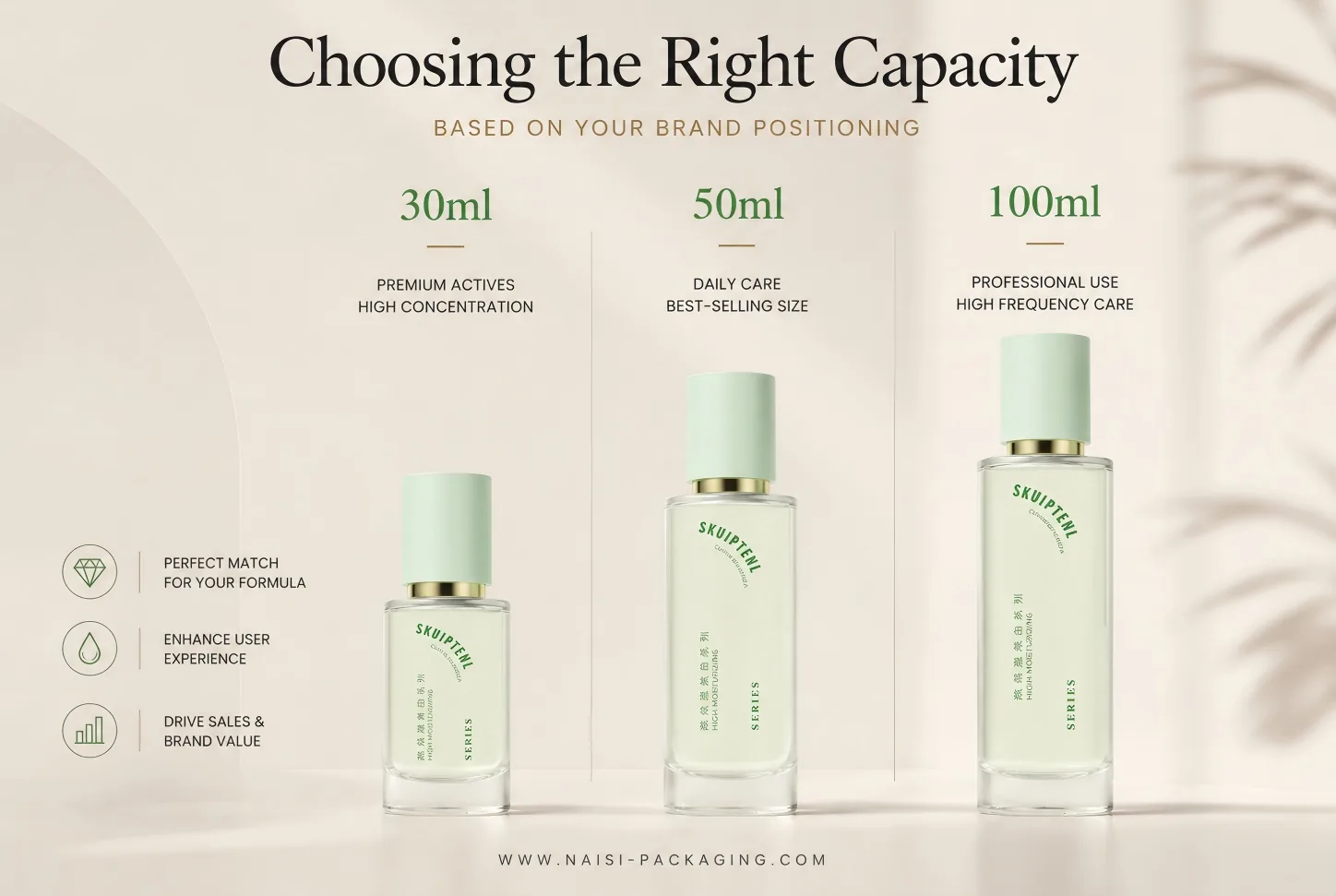
Selecting the right bottle capacity influences much more than product volume. It affects pricing strategy, consumer expectations, shipping costs, daily usage habits, and even how a product is positioned within a skincare collection.
While brands often focus on appearance first, choosing the appropriate size creates a stronger balance between commercial value and user experience.
30ml Serum Bottles
The 30ml serum bottle remains the most recognized format in premium skincare.
Consumers associate this size with concentrated formulas, advanced active ingredients, and higher value products. It is particularly suitable for brightening serums, anti aging treatments, peptide concentrates, retinol products, and targeted skincare solutions.
For beauty brands, 30ml packaging also creates greater flexibility for seasonal launches and limited collections. Smaller production volumes allow faster product updates while maintaining a premium image.
From a retail perspective, the compact size photographs well for e commerce, fits comfortably into skincare routines, and aligns with consumer expectations across global beauty markets.
50ml Serum Bottles
A 50ml serum bottle offers an excellent balance between perceived value and everyday practicality.
Many hydration serums, barrier repair products, and daily treatment formulas perform well in this format because consumers appreciate a longer usage cycle while still experiencing a premium presentation.
For direct to consumer brands, 50ml packaging often supports stronger value perception without significantly increasing packaging complexity.
It also allows brands to create matching product families alongside toner bottles, lotion bottles, and cream jars, establishing a consistent visual identity across the entire skincare line.
100ml Glass Bottles
Although less common for facial serums, 100ml glass bottles are increasingly used for professional skincare, body serums, scalp treatments, facial oils, and clinic oriented product lines.
Larger capacities communicate generous value and suit products designed for frequent application or professional use.
Brands serving salons, spas, dermatology clinics, or wellness markets often include larger glass bottles within their packaging portfolio to accommodate different customer needs.
Choosing Capacity Based on Brand Positioning
There is no universal "best" size.
Instead, capacity should support the overall product strategy.
A premium active serum benefits from a compact presentation that highlights exclusivity.
An everyday hydration product may encourage repeat use with a slightly larger bottle.
Professional treatment collections often require higher capacities to meet frequent application needs.
The most successful skincare brands build their packaging systems around how customers actually use the product, rather than simply maximizing bottle volume.
Crimp Neck vs Screw Neck
The neck finish is one of the most overlooked elements of serum bottle packaging, yet it directly influences filling efficiency, dispensing performance, component compatibility, and overall user experience.
Selecting the correct neck finish early in product development helps simplify production while ensuring reliable assembly between the glass bottle and dispensing components.
FEA Crimp Neck
FEA crimp neck bottles are widely used in premium cosmetic packaging, particularly for serum bottles fitted with treatment pumps.
The pump is secured by crimping an aluminum collar onto the bottle after filling, creating a clean and refined appearance with excellent sealing performance.
Many prestige skincare brands prefer this construction because it delivers a sleek aesthetic while helping maintain consistent dispensing performance throughout the product's life cycle.
Among available specifications, FEA 15 is one of the most commonly used standards for cosmetic serum bottles and is compatible with a wide range of industry standard treatment pumps.
Since crimp pumps are permanently attached during assembly, they also provide a polished finish that aligns well with luxury skincare positioning.
Screw Neck Bottles
Screw neck serum bottles use threaded glass finishes that allow pumps, droppers, or caps to be installed by screwing them onto the bottle.
This structure offers excellent flexibility during product development.
Many brands choose screw neck bottles when creating facial oils, botanical serums, sample collections, or products requiring different dispensing options.
Because components can be exchanged more easily during sampling and testing, screw neck bottles are often practical for product development and small batch projects.
They are also widely available in stock bottle collections, making them an attractive option for brands seeking lower minimum order quantities and shorter lead times.
Which Neck Finish Should You Choose?
Both systems are widely used throughout the cosmetic glass packaging industry.
The best choice depends on the product concept, filling process, and desired consumer experience.
Brands emphasizing prestige retail presentation often prefer FEA crimp neck bottles with treatment pumps.
Brands requiring greater flexibility during development or wishing to offer different dispensing options frequently choose screw neck designs.
Regardless of the selected system, bottles, pumps, collars, and closures should always undergo compatibility testing before mass production to ensure reliable sealing and dispensing performance.
Compliance Reminder: Neck finish dimensions such as FEA 15 follow recognized industry standards. However, compatibility between the bottle, pump, gasket, and formulation should always be verified through production trials and supplier testing before commercial filling. This step should be confirmed for every new packaging combination.
Best Decoration Finishes for Serum Bottles
Surface decoration transforms a standard glass bottle into a product that reflects a brand's personality.
For serum packaging, decoration should enhance visual appeal while remaining compatible with the intended manufacturing process and product positioning.
The most successful designs often rely on carefully selected finishes rather than excessive decoration.
Frosted Finish
Frosted glass remains one of the most recognizable finishes in premium skincare.
Its soft matte texture communicates purity, sophistication, and understated luxury.
The finish diffuses light beautifully, creating an elegant appearance that complements both minimalist branding and high end treatment collections.
When applied to High Flint glass, frosting produces exceptional visual depth while maintaining a refined, contemporary aesthetic.
Screen Printing
Silk screen printing offers excellent durability and sharp graphic definition directly on the glass surface.
It is ideal for logos, product names, ingredient highlights, and minimalist typography.
Compared with adhesive Frenchs, direct printing creates a cleaner appearance and supports a premium brand image.
Hot Stamping
Hot stamping adds metallic accents that immediately elevate shelf presence.
Gold, champagne gold, silver, and rose gold remain popular choices for luxury skincare collections.
When used selectively for brand marks or decorative details, metallic foil creates contrast without overwhelming the overall design.
Spray Coating
Spray coating allows brands to introduce custom colors while maintaining consistent visual identity across an entire product range.
Soft neutral tones, translucent gradients, and sophisticated color transitions are increasingly popular for contemporary skincare packaging.
The coating system should always be selected according to the intended production process and product requirements.
Metallized Decorative Components
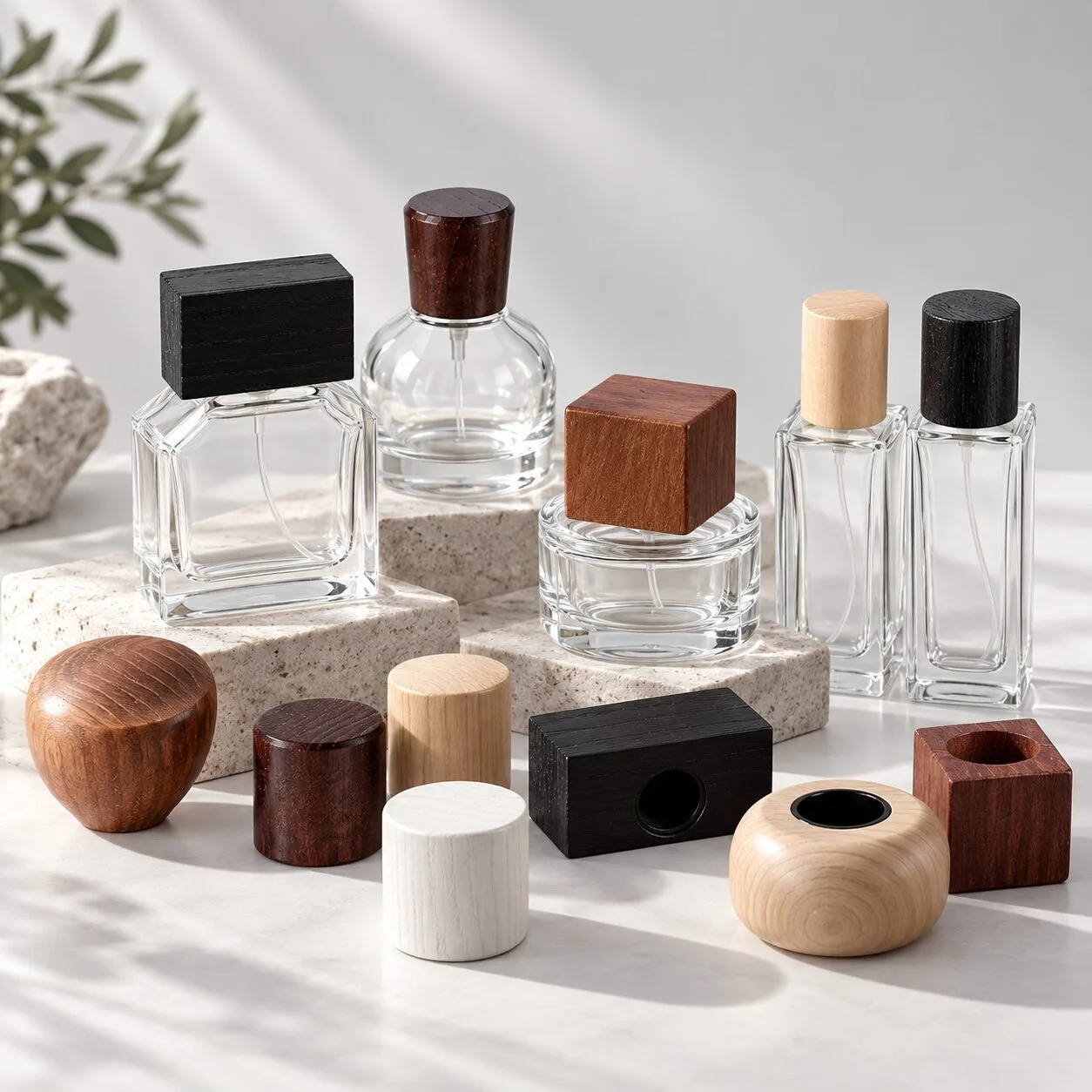
Decorative collars, caps, and accent rings with metallic finishes add depth and perceived value without changing the bottle structure itself.
Many premium skincare collections combine frosted glass with champagne gold or brushed metallic components to create a refined visual language that remains timeless.
Keep Decoration Consistent With Brand Positioning
Successful serum packaging rarely depends on using every available decoration technique.
A clear design direction usually creates stronger brand recognition.
Minimalist brands often achieve the greatest impact through frosted High Flint glass, precise screen printing, and subtle metallic accents.
Luxury collections may introduce additional decorative elements while maintaining clean proportions and consistent material quality.
The objective is to create packaging that reflects the value of the formula while supporting efficient manufacturing and long term production consistency.
How to Match Serum Packaging With Your Brand Positioning
The most successful serum packaging does more than look attractive. It communicates your brand story, reinforces your price point, and helps consumers immediately understand where your product belongs in the market.
When the packaging aligns with your brand positioning, every visual detail works together to build recognition and trust.
Clean Beauty and Minimalist Brands
Consumers attracted to clean beauty often appreciate simplicity, transparency, and timeless design.
For these brands, High Flint glass paired with a clear or frosted finish creates an elegant appearance without unnecessary decoration. A subtle logo applied through screen printing or delicate hot stamping allows the packaging to feel refined while keeping the product itself at the center of attention.
Neutral colors, balanced proportions, and consistent bottle shapes help create a modern product family that works across multiple skincare categories.
Premium Anti Aging Collections
High performance skincare deserves packaging that reflects its value.
Premium anti aging serums often benefit from thicker glass, frosted surfaces, and carefully selected metallic accents. Champagne gold collars, aluminum caps, or decorative rings add sophistication while maintaining a clean visual language.
Rather than relying on elaborate graphics, luxury brands typically emphasize material quality, precision finishing, and excellent tactile experience.
Consumers frequently associate heavier glass and refined details with premium craftsmanship.
Modern Direct to Consumer Brands
Digital first skincare brands need packaging that performs equally well on a mobile screen and in a customer's hand.
Clean bottle silhouettes, contemporary color palettes, and distinctive decorative finishes help products stand out in product photography, short form videos, and influencer content.
Soft gradients, translucent coatings, and selective metallic details create visual interest while maintaining production efficiency.
The goal is to design packaging that attracts attention online and delivers the same premium impression after purchase.
Professional Skincare and Clinical Collections
Products developed for dermatology clinics, aesthetic centers, or professional skincare lines often follow a different design philosophy.
Amber glass, understated typography, and functional dispensing systems communicate expertise and product performance rather than decoration.
This restrained approach reinforces confidence and supports brands that emphasize formulation science and professional results.
Create a Consistent Packaging System
Customers rarely purchase a single product.
Many skincare routines include cleansers, toners, serums, lotions, eye creams, and moisturizers.
Building a consistent packaging family strengthens brand recognition across every product category.
Matching bottle proportions, coordinated finishes, and unified decorative elements create a premium shelf presence while simplifying future product expansion.
As new products are introduced, customers immediately recognize them as part of the same collection.
Common Serum Bottle Packaging Mistakes to Avoid
Beautiful packaging begins with good decisions during product development.
Many challenges that appear during production or after launch can be avoided by selecting appropriate packaging from the beginning.
Choosing Packaging Based Only on Appearance
Visual appeal is important, but it should always be evaluated together with formulation requirements and production compatibility.
A bottle that looks beautiful in a rendering should also support stable filling, reliable dispensing, and consistent manufacturing.
Successful packaging combines aesthetics with practical performance.
Selecting Glass Material Without Considering Product Positioning
Different glass materials communicate different levels of quality.
High Flint glass supports premium positioning through exceptional clarity.
Frosted finishes reinforce luxury and minimalist aesthetics.
Amber glass naturally complements professional and ingredient focused product lines.
Selecting materials that align with your brand story creates stronger market recognition and a more cohesive customer experience.
Overcomplicating Decoration
Luxury packaging is often defined by restraint.
Carefully chosen decoration techniques usually create a stronger impression than combining multiple finishes on one bottle.
A balanced combination of frosting, screen printing, and selective hot stamping frequently delivers a timeless appearance that remains attractive across changing design trends.
Overlooking Component Compatibility
The bottle is only one part of the complete packaging system.
Pumps, droppers, collars, caps, and seals should function together as a complete assembly.
Every new packaging combination should undergo filling trials and compatibility testing before commercial production to confirm dispensing performance, sealing quality, and overall user experience.
Ignoring Long Term Production Consistency
A beautiful prototype represents only the first step.
Consistent material quality, decoration accuracy, color control, and dimensional stability across future production batches are equally important.
Working with suppliers that maintain standardized manufacturing processes helps brands achieve greater consistency throughout product life cycles.
Planning Every Product as a Fully Custom Project
Many emerging skincare brands assume premium packaging requires custom molds from the very beginning.
In reality, numerous successful brands launch using high quality stock glass bottles enhanced with carefully selected decoration.
This approach shortens development time, reduces initial investment, and allows packaging to evolve naturally as the product line grows.
Our Premium Serum Bottle Packaging Solution
At NAISI Packaging, we help skincare brands develop cosmetic glass packaging that combines premium aesthetics with practical manufacturing solutions.
Whether you are launching your first serum or expanding an established product line, our packaging portfolio supports every stage of product development.
Extensive Stock Glass Bottle Collection
Our standard collection includes premium serum bottles in popular capacities such as 30ml, 50ml, and 100ml, allowing brands to begin with proven bottle designs while maintaining greater flexibility for product launches.
Stock bottles can significantly shorten development cycles and simplify inventory planning for growing beauty brands.
Multiple Glass Material Options
Different product categories require different visual identities.
We offer High Flint glass, frosted glass, amber glass, and a wide range of decorative possibilities, allowing brands to select packaging that aligns with both formulation characteristics and market positioning.
Flexible Custom Decoration
For brands seeking distinctive packaging without developing entirely new molds, we provide a range of decoration services including:
· Frosted finishes
· Silk screen printing
· Hot stamping
· Spray coating
· Decorative metallic components
These options allow beauty brands to create a unique appearance while maintaining reasonable development costs and flexible production quantities.
One Stop Packaging Development
Our integrated production process covers bottle manufacturing, surface decoration, component matching, quality inspection, and packaging assembly coordination.
Working with a single supplier simplifies communication, shortens development timelines, and supports greater consistency from sampling through mass production.
Quality and International Market Support
For brands supplying international markets, packaging quality extends beyond appearance.
Material documentation, compatibility evaluation, production consistency, and market specific compliance requirements all deserve careful attention during packaging development.
Compliance Reminder: Cosmetic packaging requirements vary by destination market. Documentation related to material safety, packaging compliance, and applicable regulations should always be confirmed according to the requirements of the importing country or region before commercial shipment. This includes PPWR-related requirements in the European market, which continue to evolve and should be reviewed against the latest official guidance.
Whether your goal is a minimalist clean beauty collection, a luxury anti aging serum, or a professional skincare line, choosing the right packaging partner helps transform creative ideas into products that perform confidently in the marketplace.
Conclusion
Choosing the right serum bottle is about much more than selecting an attractive container.
Every packaging decision influences how consumers experience your product, how efficiently your team manages production, and how confidently your brand competes in a crowded beauty market.
Glass material affects clarity, premium perception, and decoration quality.
Bottle capacity shapes pricing strategy, purchasing behavior, and product positioning.
The neck finish determines compatibility with pumps or droppers, while surface decoration creates the visual identity that customers recognize across retail shelves, e commerce platforms, and social media.
When these elements work together, packaging becomes a strategic business asset rather than a production expense.
For emerging skincare brands, there is also an important lesson.
Premium packaging does not always require a completely custom bottle. Many successful brands launch with proven stock glass bottles, then build a distinctive identity through thoughtful decoration, coordinated components, and consistent branding. This approach shortens development time, improves budget efficiency, and creates flexibility for future product expansion.
As your brand grows, your packaging can evolve alongside it while maintaining a recognizable visual language.
The best serum packaging protects your formula, supports your positioning, enhances the customer experience, and strengthens long term brand value.
Those objectives work together. When achieved successfully, packaging becomes one of the most effective investments a beauty brand can make.
Frequently Asked Questions
1:What is the best glass material for serum bottles?
There is no single material that suits every product.
High Flint glass is widely chosen for premium skincare because of its exceptional clarity and refined appearance. Frosted glass creates a soft, luxurious aesthetic, while amber glass is commonly selected for formulations that benefit from enhanced light protection.
The right choice depends on your formulation, brand positioning, and desired customer experience.
2:Is a 30ml or 50ml serum bottle better?
Both capacities are popular across the skincare industry.
A 30ml bottle is often associated with concentrated, premium formulations and remains the standard size for many facial serums.
A 50ml bottle offers greater perceived value and works well for hydrating serums and daily treatment products.
The ideal capacity should match your pricing strategy and how customers are expected to use the product.
3:Should I choose a crimp neck or a screw neck serum bottle?
FEA crimp neck bottles are commonly used with treatment pumps for premium skincare collections, offering a clean appearance and secure assembly.
Screw neck bottles provide greater flexibility for droppers, pumps, and interchangeable closures, making them a practical option for product development and smaller production runs.
Your filling process and dispensing requirements should guide the final decision.
4:Which decoration finish works best for luxury serum packaging?
Many luxury skincare brands combine High Flint glass with frosted finishes, silk screen printing, and selective hot stamping.
This combination creates an elegant appearance while maintaining long term design consistency.
The most successful decoration strategy is one that reflects your brand identity rather than simply adding multiple finishing techniques.
5:Can startup beauty brands create premium serum packaging with a low MOQ?
Yes.
Many emerging brands begin with high quality stock cosmetic glass bottles and personalize them using light customization such as frosting, screen printing, hot stamping, or spray coating.
This approach reduces development costs while maintaining a premium presentation and provides greater flexibility for future product expansion.
Compliance Reminder
Before commercial production or export, always confirm that your packaging materials, decoration processes, Frenching, and documentation meet the regulatory requirements of your target market.
For brands supplying the European Union, packaging should be reviewed against the latest PPWR (Packaging and Packaging Waste Regulation) requirements and any applicable national implementation rules. Since these regulations continue to evolve, the latest official guidance should always be verified before shipment.
Likewise, compatibility testing between the serum formulation, glass bottle, pump or dropper, gasket, and decoration should be completed before mass production to ensure reliable product performance.